Orthopedic visits involve physical examination requiring both hands. Typing during range of motion testing interrupts workflow. Documenting special tests while performing them is impossible. Traditional charting happens after examining patients, stealing time and creating backlog.
Amplify by Harris CareTracker uses ambient listening to capture orthopedic encounters while they happen. Record the conversation and examination. AI transcription separates your clinical assessment from patient history. Structured summaries generate organized by
orthopedic documentation requirements. Review and sign minutes later instead of typing for thirty minutes after each patient.


You perform total knee replacement. The EHR template asks about diabetes management. You inject a shoulder. The billing system misses the appropriate modifier reducing reimbursement by 30 percent. You see post operative follow up. Documentation requirements differ from initial consultation but the software treats them identically.
Generic practice management software ignores orthopedic reality. Templates built for primary care waste surgical specialty time. Billing systems lacking procedure specific rules create revenue leakage. Scheduling tools cannot handle OR blocks and procedure duration variations. Prior authorization workflows designed for office visits fail with surgical cases.
Every day you fight software designed for someone else’s specialty.
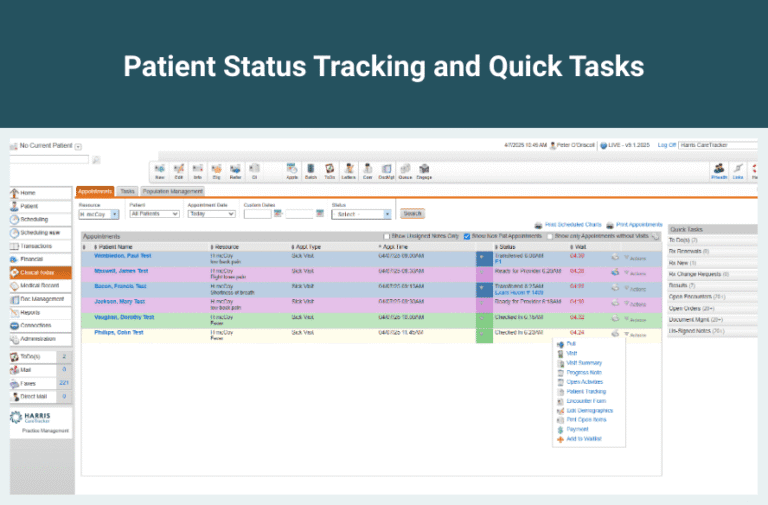
Harris CareTracker eliminates this friction. Orthopedic templates document procedures, injections, and examinations efficiently. Billing workflows understand modifiers, surgical packages, and global periods. Scheduling handles OR time, procedure complexity, and post operative visits. Prior authorization management tracks surgical cases through approval and clearance.
Orthopedic practices operate differently than primary care. Surgical procedures require detailed operative notes. Injections need specific anatomical documentation. Fracture care involves treatment plans spanning weeks. DME prescriptions connect with billing. Physical therapy referrals require coordination.
Harris CareTracker workflows match orthopedic operational reality instead of forcing your specialty into generic templates.
Total joint replacements, arthroscopy, fracture repair, and orthopedic surgeries demand comprehensive documentation meeting regulatory requirements and supporting appropriate coding. Templates capture preoperative diagnosis, surgical approach, procedure details, implant information, intraoperative findings, complications if any, and postoperative instructions.
Surgical documentation flows directly into billing. Procedure codes generate from operative notes. Modifiers apply automatically based on procedure combinations. Global period tracking prevents claim denials from inappropriate follow up billing.
Orthopedic EHR practices perform numerous injections including joint injections, trigger point injections, and viscosupplementation. Each requires anatomical location specificity, laterality documentation, and medication recording supporting accurate billing.
Templates capture injection site with anatomical detail. Laterality codes automatically. Medication type and dosage document. Ultrasound guidance if used notes appropriately. Follow up timing schedules based on medication protocol.
Injection billing requires precision. Missing laterality modifier reduces reimbursement. Incorrect CPT code selection creates denials. Inadequate documentation triggers audits. Templates prevent these revenue losses.
Fracture treatment involves initial care, casting or splinting, follow up monitoring, and eventual resolution. Documentation must support initial treatment codes, casting application, follow up care within global period, and treatment completion.
Harris CareTracker fracture care workflows track entire treatment episode. Initial encounter documents fracture type, treatment approach, and reduction if performed. Casting application records material type and anatomical extent. Follow up visits note healing progress. Global period tracking ensures appropriate billing throughout treatment course.
Fracture care billing complexity requires careful documentation. Initial treatment versus subsequent care coding differs. Global period rules determine what bills separately. Templates ensure compliance while accelerating documentation.
Orthopedic examinations focus on musculoskeletal system requiring joint specific assessments, range of motion measurements, strength testing, and special test documentation. Generic physical exam templates waste time with irrelevant review of systems.
Orthopedic exam templates focus on relevant findings. Joint specific assessments. Gait analysis. Neurovascular status. Documentation supports medical necessity and appropriate evaluation level coding.
Focused templates save time while capturing billable elements. Complete documentation supports higher level E and M coding. Comparison tracking shows treatment effectiveness.
Orthopedic billing involves surgical procedures, modifiers, global periods, DME, injections, imaging, and physical therapy. Each component has specific coding requirements. Errors cost thousands in lost revenue and denial rework.
Harris CareTracker revenue cycle management automates orthopedic billing complexity. Procedure specific scrubbing catches modifier errors. Global period tracking prevents inappropriate billing. Prior authorization workflows manage surgical cases. Denial management identifies patterns specific to orthopedic claims.
Orthopedic surgeries frequently involve multiple procedures requiring modifier application for appropriate reimbursement. Bilateral procedures need modifier 50. Staged procedures use modifier 58. Unrelated procedures during global period require modifier 79.
Automated billing applies modifiers based on procedure combinations and timing. Templates capture information determining which modifiers apply. Claims submit with appropriate modifiers preventing denials and maximizing reimbursement.
Surgical billing automation:
Modifier errors cost orthopedic practices significant revenue. Missing modifier 50 cuts bilateral payment in half. Incorrect modifier 51 sequencing reduces reimbursement. Automated application eliminates these losses.
Orthopedic practices dispense durable medical equipment including braces, walking boots, crutches, and immobilizers. Supply billing requires tracking inventory, documenting medical necessity, and submitting appropriate HCPCS codes.
Harris CareTracker integrates DME with clinical documentation. Prescription documented during visit. Inventory tracked when dispensed. Billing generated automatically with HCPCS codes. Medical necessity documented supporting coverage.
DME represents meaningful revenue stream if billed correctly. Missing documentation creates denials. Inventory shrinkage from unbilled items costs money. Integration captures all revenue.
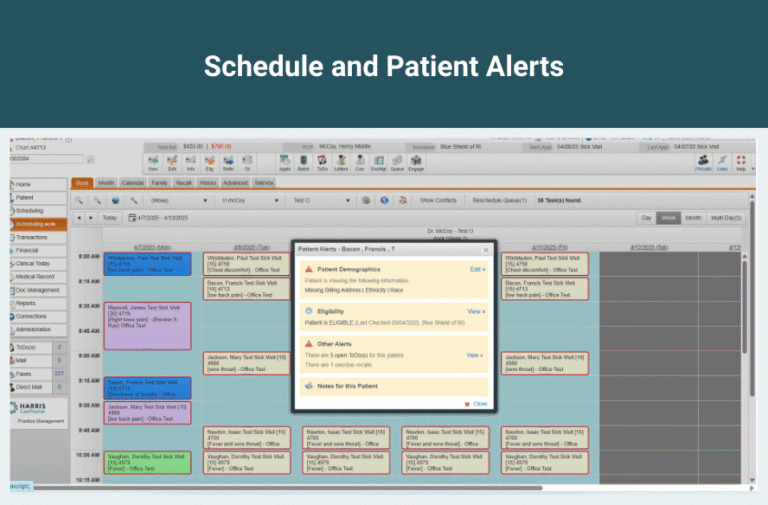
Orthopedic practices juggle office visits, injection procedures, surgical cases, and post operative care. Scheduling complexity exceeds typical outpatient practices. OR time coordination, procedure duration variation, and post operative follow up timing require sophisticated scheduling tools.
Harris CareTracker practice management handles orthopedic scheduling complexity. OR block management, procedure time templates, equipment tracking, and staff coordination optimize practice flow.
Surgical cases require coordination with hospital or surgery center OR schedules. Block time management, procedure duration estimation, equipment needs, and staff availability all affect scheduling.
Efficient surgical scheduling maximizes OR utilization. Accurate time estimation prevents delays. Equipment coordination eliminates case cancellations. Templates streamline complex workflow.
Office schedules mix brief post operative checks, new patient consultations, injection procedures, and casting applications. Each visit type requires different duration and resources.
Appointment templates specify duration by visit type. New patients get adequate time. Post operative checks schedule appropriately brief. Injection procedures include setup time. Templates prevent overbooking while maximizing provider productivity.
Proper scheduling improves patient satisfaction and provider efficiency. Rushed visits from overbooking create complaints. Unused time from conservative scheduling reduces revenue. Templates balance both.
Physical examination dominates orthopedic visits. Range of motion testing. Strength assessment. Special tests. Gait evaluation. Neurovascular checks. Performing these examinations while documenting is impossible with traditional EHR.
Ambient listening solves this. Verbally describe findings during examination. AI captures anatomical location, measurement values, test results, and clinical interpretation. Structured documentation generates with orthopedic exam findings organized appropriately.
Document while examining. Review structured summary after visit. Edit gaps where ambient capture missed details. Sign and move to next patient. Documentation finishes during clinic day instead of extending into evening.
New patient surgical consultations require comprehensive history, physical examination, imaging review, treatment option discussion, and surgical planning. Documentation supporting medical necessity and informed consent takes longer than the actual visit using traditional methods.
Ambient listening captures entire consultation conversation. Patient history of injury or condition. Symptoms and functional limitations. Treatment already attempted. Imaging findings discussion. Surgical versus conservative options. Risk and benefit explanation. Patient questions and concerns.
AI generates structured consultation note including history of present illness, examination findings, imaging interpretation, assessment, and treatment plan. Surgical procedure if recommended documents with appropriate detail. Informed consent discussion captured.
Consultation documentation completing in minutes instead of thirty minutes improves provider capacity and work life balance. Same quality documentation in fraction of the time.
Orthopedic practice success requires understanding procedure volume, payer mix, surgical versus non surgical revenue, referral patterns, and outcome tracking. Analytics inform decisions about service lines, staffing, equipment investment, and growth opportunities.
Generic practice software ignores orthopedic reality. Missing modifiers cost thousands monthly. Inadequate templates slow documentation. Scheduling tools cannot handle OR coordination. Revenue leaks through billing errors.
Harris CareTracker eliminates this friction. Orthopedic EHR templates accelerate documentation. Automated billing captures all revenue. Surgical scheduling coordinates complex workflows. Amplify ambient listening documents encounters while you examine patients.
Stop fighting software designed for primary care. Start operating with infrastructure built for orthopedic practices.
We chose Harris CareTracker for our office because of its cost-effectiveness and since changing to them, we have seen a significant increase in our monthly savings. The standout feature has been the excellent customer support and training!
It’s really easy to use Harris CareTracker Practice Management. Very easy to learn.
We have used Harris CareTracker in our practice for 5 years, and it has been a wonderful experience. The trainers and on-going support teams are knowledgeable, accessible, and quick to respond to queries. They provided easy-to-follow step-by-step guidance for using the software. They never failed me. I highly recommend CareTracker for practices of any size.
Where here for anything you need, just drop a line and we’ll get back to you.