Chronic care management turning Medicare patients into recurring revenue
Two thirds of Medicare patients have multiple chronic conditions qualifying for monthly care management reimbursement. Your practice sees them occasionally. Between visits, symptoms worsen, medications get skipped, hospitalizations happen. HARRIS CareTracker offers chronic care management services delivered by Esrun, another HARRIS Healthcare company. This captures recurring revenue opportunity without adding internal staff burden. Medicare pays monthly. Your practice collects. Patients stay healthier. Revenue stabilizes into predictable stream.
Why Choose Us?

HIPAA Secure

Medicare Compliant Billing

CCM by HARRIS CareTracker and Esrun

24/7 Patient Access
The Care Gap between Visits is Costing you Money and Harming Patients
Patient leaves your office with new medications and specialist referrals. You documented everything. Billed the visit. Said see you in three months.
What happens next determines outcomes and costs. Does the patient fill prescriptions? Are they taking medications correctly? Did they schedule the specialist? Are symptoms improving or worsening?
Without structured oversight during the 2,000 waking hours between office visits, chronic disease patients deteriorate silently. Medication errors accumulate. Symptoms escalate unchecked. Minor problems become emergencies.
The patient calls 911 at 2am. Emergency department visit costs Medicare $1,200. Hospital admission follows costing $15,000. Thirty days later, patient readmits. Another $12,000. All preventable with proactive management catching problems early.
Medicare loses money. Patient suffers. Your practice captures nothing for the crisis that structured monthly oversight would have prevented.
Chronic care management from HARRIS CareTracker fills this gap. Esrun, a HARRIS Healthcare partner company, provides the licensed nurses who contact patients monthly. Medication adherence monitored. Symptoms tracked. Problems escalate to your practice before becoming emergencies. Medicare pays monthly for this coordination. Revenue flows to your practice. Patient outcomes improve.
What Chronic Care Management is and Why Medicare pays for it
Approximately 6 in 10 Americans live with at least one chronic condition. Four in 10 manage two or more. Chronic diseases consume over 90 percent of the $4.5 trillion annual healthcare spending. Seven out of ten deaths result from chronic disease complications.
Medicare recognizes that episodic office visits cannot manage chronic disease effectively. Structured coordination between encounters reduces hospitalizations by 25 to 60 percent through early intervention preventing acute crises.
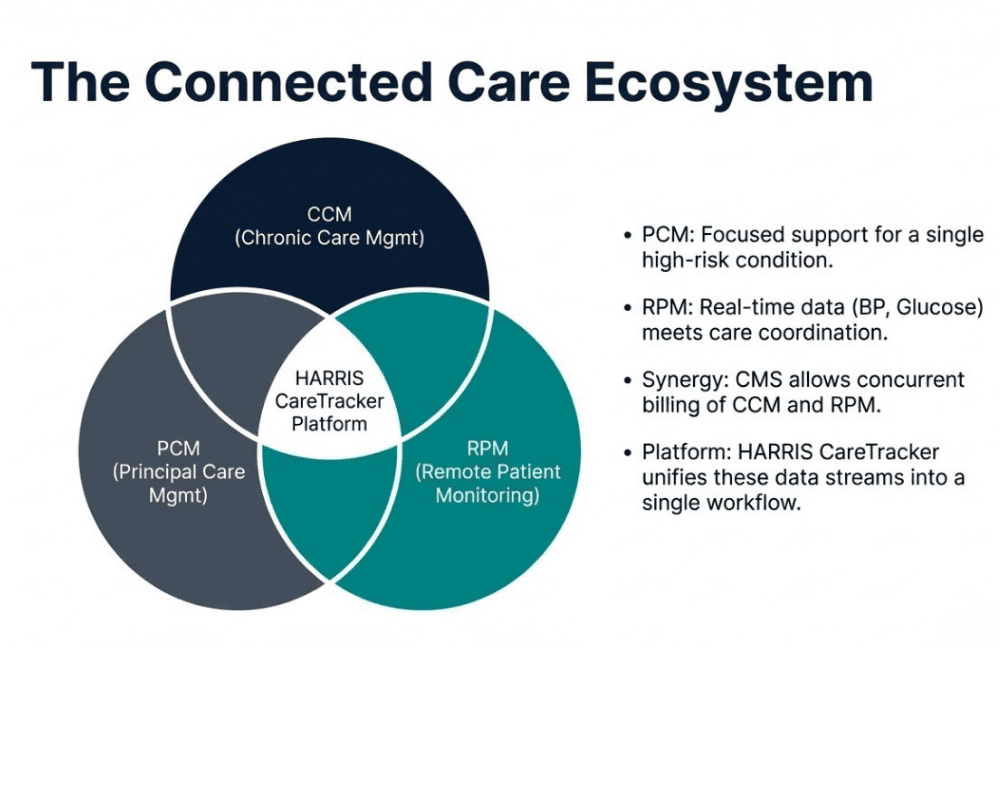
HARRIS CareTracker provides this structured coordination through its partnership with Esrun, creating billable monthly revenue for participating practices.
Medicare Eligibility Requirements
Chronic care management billing requires patients meeting specific criteria.
Patient eligibility
- Two or more chronic conditions expected to last at least 12 months or until death
- Chronic conditions place patient at significant risk of death, acute exacerbation, or functional decline
- Medicare Part B coverage active
- Patient consent obtained documenting agreement and cost sharing understanding
Common qualifying conditions:
- Diabetes
- Hypertension
- Heart failure
- COPD
- Chronic kidney disease
- Depression
- Anxiety
- Osteoarthritis
- Asthma, coronary artery disease
- Atrial fibrillation
- Obesity
- Hyperlipidemia
- Cancer
Approximately 67.3% of Medicare fee for service beneficiaries meet eligibility criteria. This represents massive addressable market within existing patient panels.
Service Requirements and Billing Codes
Medicare reimburses monthly when specific service requirements meet documentation standards.
Core service components
- Comprehensive care plan creation and maintenance accessible 24/7
- Medication management including reconciliation and adherence monitoring
- Coordination with other treating providers and community services
- Enhanced communication access with care team
- Systematic assessment and monitoring between office visits
- Management of care transitions including post hospitalization follow up
Primary billing codes with 2026 reimbursement:
- CPT 99490: First 20 minutes monthly, approximately $66 reimbursement
- CPT 99439: Each additional 20 minutes, approximately $53 reimbursement
- CPT 99491: Complex chronic care requiring 30 minutes by physician or qualified practitioner, approximately $95 reimbursement
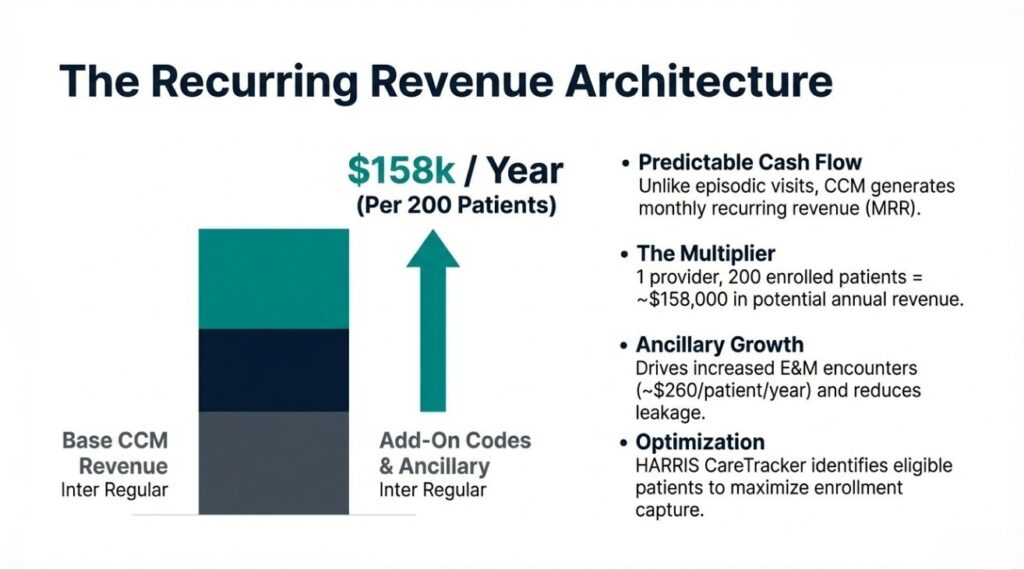
Monthly billing creates recurring revenue stream. Single patient generating $66 monthly produces $792 annually. Panel of 200 patients generates $158,400 annual recurring revenue before accounting for additional time based codes.
How Practices Generate Profit using Care Coordination Services
Chronic care management profitability derives from Medicare paying practices for services delivered by clinical teams. Your practice bills Medicare directly. Esrun handles the patient outreach, care coordination, and documentation on behalf of HARRIS CareTracker. Your practice retains the margin between Medicare reimbursement and service fees.
Direct Monthly Revenue Calculation
Medicare reimburses practices monthly for qualified chronic care management services. The care coordination team from Esrun handles patient enrollment, monthly contact, documentation, and compliance.
Revenue mathematics per patient:
Monthly Medicare reimbursement for CPT 99490 averages $66. Annual reimbursement per enrolled patient equals $792 assuming consistent monthly qualification.
Scale impact:
- 100 enrolled patients: $79,200 annual revenue
- 200 enrolled patients: $158,400 annual revenue
- 450 enrolled patients: $356,400 annual revenue
Service fees vary by agreement structure but the model ensures your practice retains meaningful margin on this recurring revenue stream requiring minimal internal staff time.
Net profit example:
Practice with 1,000 Medicare patients achieves 45 percent enrollment using professional enrollment support from Esrun. 450 enrolled patients generate $356,400 gross annual revenue. After service fees, practice retains significant net profit with zero added internal workload.
Contrast with internal programs averaging 10 percent enrollment due to staff capacity constraints. Same 1,000 patient panel yields only 100 enrollments and $79,200 gross revenue while consuming staff time for enrollment, monthly calls, and documentation.
Additional Revenue from Increased Patient Engagement
Chronic care management enrolled patients generate approximately $260 additional annual revenue beyond the monthly care management codes through increased evaluation and management visits, preventive screenings, and lab testing.
Halo effect mechanisms:
Care coordinators identify overdue screenings prompting office visits. Medication adjustments require follow up appointments. Chronic disease monitoring creates additional billable encounters. Patient engagement increases utilization of appropriate preventive and diagnostic services.
Leakage prevention:
Regular contact keeps patients connected to primary practice instead of seeking care at urgent care centers or through specialists without referral. Revenue stays within practice network rather than leaking to external providers.
Combined direct chronic care management revenue plus indirect increased encounters creates substantial total financial impact exceeding $1,000 annual revenue per enrolled patient.
MIPS Performance Improvement Value
Chronic care management activities contribute significantly to Merit Based Incentive Payment System performance avoiding penalties and potentially earning bonuses.
- Quality measure impact:
Care management data automatically satisfies multiple quality measures including medication reconciliation, depression screening, care plan documentation, and care coordination metrics.
- Improvement activities credit:
Chronic care management qualifies for improvement activities scoring providing automatic MIPS credit protecting against performance penalties.
- Cost category optimization:
Reduced emergency department utilization and hospitalizations lower total per capita costs attributed to providers improving cost performance scores.
- Penalty avoidance value:
Failure to meet MIPS thresholds triggers up to negative 9 percent penalty on all Medicare Part B claims. For practice billing $800,000 annually to Medicare Part B, this represents $72,000 potential penalty. Chronic care management activities help avoid this downside risk.
Positive MIPS performance can generate up to 1.88 percent bonus on Medicare Part B revenue. Combined penalty avoidance and bonus opportunity creates significant financial protection beyond direct care management billing.
How Chronic Care Management Improves Patient Health and Reduces Costs
Structured care coordination between office visits transforms reactive crisis management into proactive health maintenance. Evidence demonstrates substantial clinical benefits and cost reductions.
Hospital Admission and Readmission Reduction
Federal studies show chronic care management reduces hospitalizations and emergency department visits significantly through early problem identification.
Research Findings
After 18 months of chronic care management enrollment, patients experienced 99 fewer hospital stays and 76 fewer emergency department visits per 1,000 patients compared to control group without care management.
Hospital Data on Readmissions
Hospitals implementing chronic care management programs report 23 to 30 percent reduction in readmission rates for chronic disease patients through improved care transitions and post discharge follow up.
Practice Reported Outcomes
One federally qualified health center documented 60 percent reduction in emergency room visits after comprehensive chronic care management implementation. Another accountable care organization achieved 20 percent decrease in hospital admissions.
Cost Impact
Medicare saves approximately $888 annually per chronic care management enrolled patient primarily through reduced hospital and emergency department utilization. These savings far exceed the monthly care management reimbursements creating positive return for Medicare program.
Medication Adherence and Safety Improvement
Improper medication management contributes to up to 50 percent of hospital readmissions among chronic disease patients. Chronic care management addresses this through systematic medication oversight.
Medication Reconciliation
Care coordinators verify medication lists match actual patient prescriptions. Discrepancies following hospital discharges or specialist visits get identified and corrected preventing dangerous errors.
Interaction and Side Effect Monitoring
Regular reviews identify potential drug interactions and monitor for adverse effects enabling timely adjustments before harm occurs.
Adherence Barrier Resolution
Coordinators identify and address adherence obstacles including cost concerns, transportation to pharmacy, confusion about instructions, or side effect worries. Connecting patients with assistance programs and simplifying regimens improves adherence rates.
Documented Improvement
Long term studies show medication adherence improvements of 5 to 9 percent among chronic care management enrolled patients. For conditions like heart failure and diabetes, adherence directly correlates with reduced acute exacerbations and hospitalizations.
Chronic Disease Control and Quality of Life
Regular monitoring and coaching help patients achieve better disease control and functional status.
Diabetes Management
One program reported 71 percent of enrolled diabetic patients showed improved hemoglobin A1C levels through adherence coaching and monitoring support.
Blood Pressure Control
Hypertensive patients receiving monthly monitoring and medication management achieve better blood pressure control than those with episodic office only care.
Symptom Management
Patients report better symptom control and quality of life through having consistent access to clinical guidance and knowing someone monitors their condition regularly.
Self-Management Skills
Education and coaching during monthly contacts improve patient understanding of their conditions and ability to manage symptoms, medications, and lifestyle modifications independently.
Complete Care Management Solution Requiring Minimal Practice Resources
Licensed Clinical Staff Delivering Care Coordination
Registered nurses and licensed practical nurses from Esrun conduct monthly patient outreach and care coordination under practice general supervision.
Clinical team capabilities:
- Medication review and reconciliation
- Symptom assessment using validated protocols
- Chronic disease monitoring and education
- Care plan updates and maintenance
- Coordination with specialists and other providers
- Post hospital discharge follows up
- Social determinant screening and resource connection
Licensed clinical staff training ensures quality interactions meeting Medicare documentation requirements and clinical standards.
Technology Platform Supporting Care Delivery
Comprehensive technology infrastructure from Esrun manages workflows, documentation, and billing compliance as part of the HARRIS CareTracker chronic care management solution.
Platform capabilities:
- Electronic health record integration enabling care plan access
- Automated patient outreach scheduling and tracking
- Time tracking for billing code qualification
- Clinical documentation templates meeting Medicare requirements
- Medication list management and interaction checking
- Care plan creation and 24/7 accessibility
- Reporting dashboards showing enrollment and billing metrics
Technology eliminates manual tracking burden ensuring billing compliance and audit readiness without practice staff involvement.
Patient Enrollment and Consent Management
Professional enrollment specialists contact eligible patients explaining program benefits, obtaining consent, and completing required documentation.
Enrollment process:
- Eligible patient identification from practice EMR and claims data
- Outbound calls explaining chronic care management benefits
- Medicare cost sharing disclosure as required
- Consent documentation meeting regulatory requirements
- Care plan initiation and baseline assessment
Enrollment expertise drives higher participation rates. Professional enrollment teams achieve 45 to 60 percent enrollment versus 10 percent typical for practice managed programs. Higher enrollment multiplies revenue potential from existing patient panels.
24/7 Patient Access Requirement Fulfillment
Medicare requires participating practices provide 24/7 access to care management services. Nurse triage lines operated by Esrun fulfill this requirement on behalf of participating practices.
After hours coverage:
Patients receive dedicated phone number for urgent questions outside business hours. Licensed nurses triage calls, provide clinical guidance, and escalate to on call providers when appropriate. This expensive requirement gets satisfied without practice investment in additional staffing.
Crisis prevention:
After-hours access prevents patients from defaulting to emergency departments for non-urgent issues. Nurse guidance resolves many concerns avoiding unnecessary expensive utilization.
Medicare Compliant Documentation and Billing Support
Chronic care management billing carries strict documentation requirements and audit risk. Comprehensive documentation maintained by the care coordination team ensures practices capture revenue without regulatory exposure.
Required Documentation Elements
Medicare audits verify specific documentation supporting chronic care management claims.
Mandatory documentation
- Initiating visit within past 12 months with face to face examination
- Comprehensive care plan electronically stored and accessible 24/7
- Patient consent with cost sharing disclosure
- Monthly time tracking showing minimum 20 minutes non face to face services
- Clinical notes documenting care coordination activities performed
- Medication reconciliation and monitoring documentation
Complete documentation gets maintained in audit ready format. Monthly billing reports provide detailed activity logs supporting submitted claims.
Billing Code Selection and Claim Submission
Appropriate code selection based on documented time and complexity determines reimbursement accuracy.
Time based code selection
- CPT 99490: 20 to 39 minutes monthly
- CPT 99439: Each additional 20 minutes
- CPT 99491: 30 minutes by physician or advanced practitioner for complex patients
Time gets tracked precisely with appropriate codes applied automatically. Practice billing staff receives monthly reports identifying billable patients and applicable codes. Claims submit through practice normal billing processes.
Regulatory Compliance and Audit Protection
Medicare fraud prevention efforts include chronic care management audits verifying services were actually provided as billed.

Audit Triggers
- Sudden enrollment increases without corresponding practice changes
- High utilization of add on time codes
- Billing for patients without documented qualifying conditions
- Missing consent or care plan documentation
- Time logs not supporting billed service levels

Audit Readiness
Comprehensive documentation including time stamps, call recordings when permitted, clinical notes, and patient consent forms gets maintained. Audit requests get fulfilled rapidly with complete supporting documentation.

Compliance Framework
Services operate within general supervision rules allowing non physician clinical staff to provide care management under physician oversight. Fair market value service agreements prevent Anti-Kickback Statute violations. Stark Law compliance maintained through appropriate contract structures.
2025 Alternative to Time Based Chronic Care Management
Advanced Primary Care Management codes launched in 2025 offer simplified billing alternative eliminating time tracking requirements. HARRIS CareTracker supports both traditional chronic care management and advanced primary care management models through its partnership with Esrun.aqq
Advanced Primary Care Management Structure
APCM bundles multiple care management services into single monthly code based on patient complexity rather than documented time.
- Billing codes:
- G0556: Patients with one or fewer chronic conditions, approximately $35 monthly
- G0557: Patients with two or more chronic conditions, approximately $54 monthly
- G0558: Qualified Medicare Beneficiaries with multiple conditions, approximately $117 monthly
- Key difference from CCM:
No time tracking required. Services provided based on patient need rather than hitting specific minute thresholds. Administrative burden reduces significantly.
- Eligibility expansion:
Unlike chronic care management requiring two chronic conditions, APCM covers all Medicare beneficiaries including those with single condition or no chronic disease.
MIPS Reporting Requirement
APCM billing requires participation in Value in Primary Care MIPS Value Pathway. This mandatory reporting obligation differs from traditional chronic care management.
- Reporting mandate:
Practices billing APCM codes must report quality measures under specific MIPS pathway. Failure to report triggers claim denials and potential negative 9 percent penalty on all Medicare Part B revenue.
- Strategic consideration:
APCM simplifies monthly documentation but adds quality reporting complexity. Practices must evaluate whether time tracking elimination outweighs mandatory MIPS pathway participation.
Both models get supported allowing practices to select optimal approach for their patient populations and operational preferences.
Launching Chronic Care Management in your Practice
Implementation follows structured process minimizing practice disruption while maximizing enrollment and revenue capture.
Patient Identification and Eligibility Verification
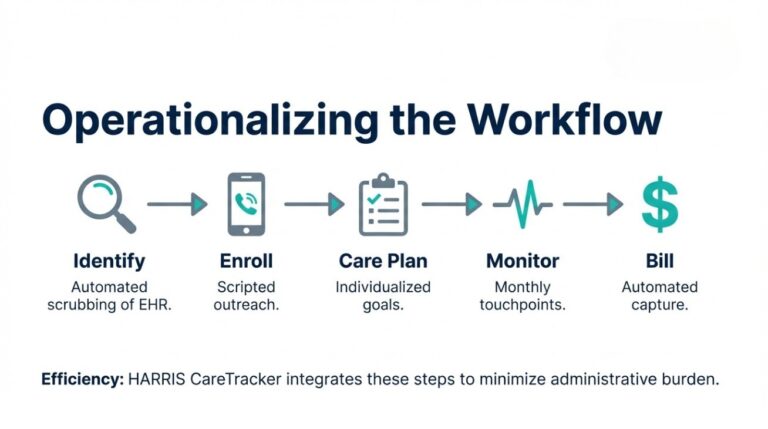
Implementation begins with identifying qualifying patients from existing practice panel.
Identification Process
Electronic health record and claims data analysis identifies patients with documented chronic conditions meeting Medicare eligibility criteria. Initial target lists focus on highest risk patients most likely to benefit from intensive coordination.
Verification
Medicare coverage confirmation and consent status checking ensure only eligible, consenting patients get enrolled avoiding billing denials.
Staff Training and Workflow Integration
Practice staff receive training on program mechanics, patient communication, and billing processes.
Training Components
- Program overview and revenue opportunity explanation
- Patient referral workflows when clinical concerns identified
- Monthly billing report review and claim submission processes
- Documentation requirements for initiating visits
Minimal practice workflow changes required since enrollment and monthly care coordination get handled by the Esrun clinical team.
Launch and Ongoing Optimization
Program launches with initial patient outreach and enrollment. Ongoing monitoring optimizes enrollment rates and clinical outcomes.
Launch Activities
- Patient outreach calls beginning enrollment
- Care plan development and baseline assessments
- Monthly care coordination calls initiating
- Billing reports generating for first month claims
Optimization
Regular performance reviews identify opportunities for increased enrollment, improved clinical interventions, and enhanced coordination with practice clinical workflows.
Chronic Care Management Creating Recurring Revenue from Existing Patients
Two thirds of your Medicare patients qualify for monthly chronic care management reimbursement. Without structured programs, this revenue opportunity and clinical benefit goes unrealized.
HARRIS CareTracker chronic care management using care coordination services from Esrun, a HARRIS Healthcare partner company, turns existing patient relationships into recurring monthly revenue. Licensed nurses coordinate care. Patients receive proactive monitoring. Hospitalizations decrease. Your practice bills Medicare monthly. Revenue stabilizes into predictable stream without adding internal staff burden.
Stop leaving chronic care management revenue uncaptured. Start generating recurring income from patients you already see.
FAQs
How secure is ambient listening with my EHR, and who has access to the recordings?
Is ambient listening really HIPAA compliant and safe for sensitive conversations?
Does ambient listening actually save time, or does it just change the type of work?
How accurate are the notes, diagnoses, and billing codes generated by ambient AI scribes?
What happens to consent, are patients told that AI is listening and recording the visit?
Does ambient listening change the medico-legal risk or malpractice exposure?
Will this technology improve burnout, or will it just add another layer of tech overhead?
How does ambient documentation handle noisy environments, interruptions, and multiple speakers?
Which ambient listening AI scribe vendors work best in practice, and how do they compare?
Does ambient listening work for all medical specialties and visit types?
How much does ambient listening cost compared to traditional documentation methods?
Can ambient listening be turned off for sensitive visits or patient requests?
Does ambient listening require special hardware or equipment in exam rooms?
How long does it take to train staff on ambient listening technology?
Will ambient listening documentation be accepted by payers and auditors?
What Our Customers Say About Us
We chose HARRIS CareTracker for our office because of its cost-effectiveness and since changing to them, we have seen a significant increase in our monthly savings. The standout feature has been the excellent customer support and training!

Tara Warnock
Billing Specialist | Naples Vascular Specialists
It’s really easy to use HARRIS CareTracker Practice Management. Very easy to learn.

Lauren O'Brien
Billing Manager | New England OB/GYN
We have used HARRIS CareTracker in our practice for 5 years, and it has been a wonderful experience. The trainers and on-going support teams are knowledgeable, accessible, and quick to respond to queries. They provided easy-to-follow step-by-step guidance for using the software. They never failed me. I highly recommend CareTracker for practices of any size.
Linda S. Erickson
Billing Specialist | John A. Nassar, MD
Get Started Today
Connect With Us
Where here for anything you need, just drop a line and we’ll get back to you.