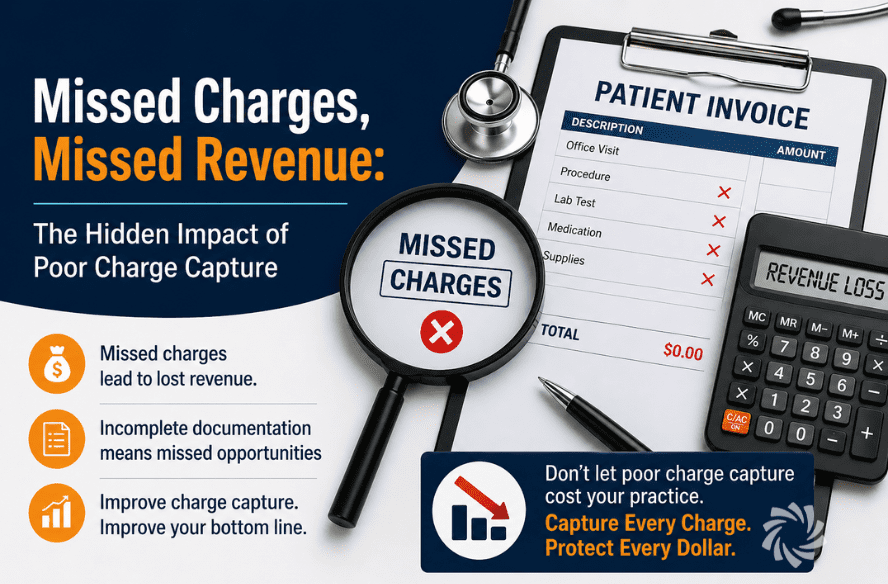
Revenue leakage is a hidden challenge that quietly drains the financial health of medical practices. While many organizations concentrate on claim denials and payer rejections, a surprisingly large portion of lost revenue happens before a claim is ever submitted, during the healthcare charge capture process.
Inefficient charge capture isn’t merely an administrative hassle; it can significantly undermine practice sustainability, slow down coding workflow efficiency, and stunt growth.
Small missed charges add up fast, turning everyday oversights into thousands of dollars in lost revenue over time.
Understanding how these missed charges accumulate and exploring proven ways to improve charge capture in healthcare is crucial for safeguarding your practice’s revenue, strengthening your financial foundation, and ensuring long-term operational success.
What is Charge Capture and Why Does It Fail?
Charge capture is the critical process of recording every medical service performed during patient visits to ensure accurate and timely billing.
Every patient encounter generates charges that need to be coded correctly and submitted to insurance providers, making precision essential.
However, with constantly changing payer rules, increasingly complex coding requirements, and a wide variety of service types, the margin for error is higher than ever.
Failures in charge capture often arise from system gaps, outdated manual processes, or unclear workflows, creating fertile ground for medical billing errors and revenue leakage.
Left unchecked, these mistakes don’t just delay payments, they quietly erode a practice’s revenue, disrupt workflow efficiency, and complicate financial planning.
Common Charge Capture Mistakes in Medical Billing
Even minor mistakes in charge capture can snowball into significant financial losses. Common charge capture mistakes in medical billing include:
- Documentation Gaps: Services provided but not noted in the patient chart remain unbilled, leaving revenue on the table.
- Lag Time: Providers who wait until the end of the week—or month—to enter charges often forget services or misremember details.
- Communication Silos: Disconnected clinical and billing teams result in incomplete or inconsistent charge records.
These errors contribute to delayed payments, increased administrative burden, and inaccurate financial reporting, making coding workflow efficiency a critical concern.
The Hidden Impacts of Poor Charge Capture
Direct Revenue Loss
Missing even a single low-level code per day may seem insignificant, but over the course of a year, these small omissions can add up to thousands of dollars in lost revenue. Practices that fail to capture every charge are effectively leaving money on the table every day.
Increased Audit Risk
Under-coding is just as problematic as over-coding. Inconsistent patterns trigger audits, which can result in penalties, repayment requests, and additional administrative headaches. Accurate charge capture reduces exposure to audit risks and ensures compliance with regulatory requirements.
Administrative Burden
Retrospective queries. where billing staff must chase providers for missing or unclear information, consume valuable time, slow the billing cycle, and potentially increase coding denials. This inefficiency not only frustrates staff but also delays revenue collection.
Distorted Data
Incomplete charge capture distorts financial reporting. Practices relying on inaccurate analytics struggle to make informed business decisions, allocate resources effectively, or identify profitable service lines.
Identifying the Leaks: Is Your Practice at Risk?
Medical billing errors are rarely due to incompetence. Fatigue, outdated processes, and manual workflows are often the real culprits. Practitioners can assess their risk by asking:
- Do you frequently find unbilled encounters at the end of the month?
- Is there a high volume of “hold” claims due to missing information?
- Are you relying on paper superbills or sticky notes to track charges?
If the answer to any of these questions is “yes,” your practice may be experiencing significant revenue leakage.
Workable Solutions: Ways to Improve Charge Capture in Healthcare
Improving charge capture doesn’t have to be complicated. Some effective strategies include:
Move to the Point of Care
Capturing charges in real-time during the patient visit, directly within the EHR, eliminates memory errors and ensures complete documentation. This approach reduces lag time and increases coding workflow efficiency.
Automate Eligibility and Coding
- Technology can verify insurance coverage upfront and assist providers with accurate code selection (CPT, ICD-10), reducing guesswork, and improving in-house medical billing workflows.
Implement a "Safety Net"
Claims scrubbing features automatically check for errors before submission, preventing lost revenue and reducing audit exposure.
Regular Audits and Education
Ongoing staff training on coding updates and periodic reviews using role-based dashboards help identify bottlenecks and prevent recurring errors.
How Harris CareTracker Plugs the Leaks
Harris CareTracker integrates EHR, practice management, and medical billing connecting with over 600+ systems to ensure clinical data flows directly into billing. This seamless integration addresses the root causes of poor charge capture and revenue leakage.
Specific Features Include:
- Coding Assistance: Automatically assigns accurate codes to minimize risk and reduce common charge capture mistakes in medical billing.
- Claims Scrubbing: Rules-based editing detects errors before claims are submitted.
- Role-Based Dashboards: Prioritizes worklists to ensure no task slips through the cracks, improving coding workflow efficiency.
By combining automation with real-time data capture, Harris CareTracker strengthens your revenue cycle, reduces administrative burden, and provides actionable insights for business decisions.
Master Charge Capture with Harris CareTracker
Accurate charge capture is the foundation of a healthy revenue cycle and Harris CareTracker ensures that every service documented in the patient record flows seamlessly into the billing system, eliminating gaps, reducing manual entry, and preventing lost revenue.
With real-time coding assistance, providers are guided to select the correct CPT and ICD-10 codes as charges are entered, reducing the risk of errors and minimizing audit exposure. Our claims scrubbing feature catches inconsistencies and potential mistakes before claims are submitted, ensuring your practice is paid accurately and on time.
And our role-based dashboards give staff a clear view of outstanding tasks, unbilled encounters, and workflow bottlenecks, so nothing slips through the cracks.
Don’t let missed charges silently drain your revenue, contact Harris CareTracker today to get started and ensure every patient encounter is captured, coded, and billed accurately.



2 Responses
you are truly a just right webmaster The site loading speed is incredible It kind of feels that youre doing any distinctive trick In addition The contents are masterwork you have done a great activity in this matter
Your writing is a true testament to your expertise and dedication to your craft. I’m continually impressed by the depth of your knowledge and the clarity of your explanations. Keep up the phenomenal work!