MIPS decides part of your Medicare pay. Most practices learn the rules the hard way.
The score follows you, and the payment adjustment lands two years later whether you planned for it or not. HARRIS CareTracker helps your practice get more from its EHR and build a clear plan for quality reporting, interoperability, registry reporting, risk adjustment, and MIPS performance, so the program stops being guesswork.

Trusted
- 30 years helping private practices report with confidence and protect their Medicare revenue.
The Rules Keep Moving, and The Penalty Does not Wait
The Quality Payment Program is hard to follow, and it does not hold still. Reporting rules, scoring methods, and participation options keep changing, and each change affects how your clinicians submit data, how Medicare judges performance, and how it adjusts your payments. A practice that misreads a rule one year pays for it two years later.
Whether your team is preparing for MIPS, weighing Advanced APM options, looking at MIPS Value Pathways, or just trying to learn what applies, our Learning Center gives you resources to make informed decisions with more confidence.
What the Quality Payment Program is
The Quality Payment Program moves Medicare providers away from volume based reimbursement and toward value based care. It gives eligible clinicians several ways to report performance data, then adjusts payment based on quality, cost, technology use, and improvement work. The program decides a share of what Medicare pays you, so understanding it is a revenue question, not a paperwork one.
How MIPS Measures and Pays your Practice
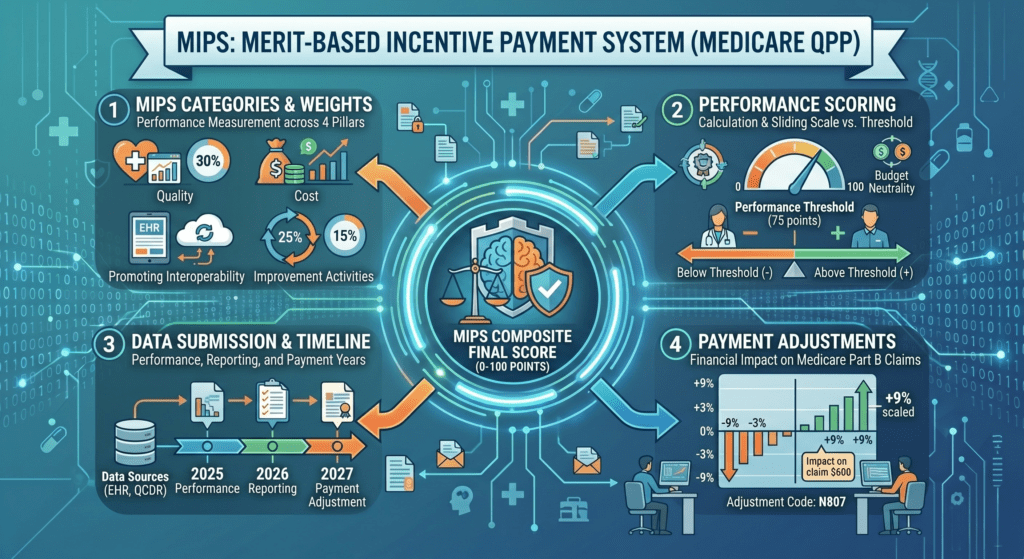
The Merit Based Incentive Payment System measures eligible clinicians and compares the results against national standards and peer performance. The program is budget neutral, so a bonus for one practice is funded by a cut to another. The adjustment reaches your Medicare Part B covered professional services two years after the performance year, which is why a missed year echoes well into the future.
The four performance categories
Your final score combines four categories. Quality counts for thirty percent of the final score across a twelve month reporting period. Cost also counts for thirty percent across a twelve month performance period. Promoting Interoperability counts for twenty five percent across a reporting period of one hundred eighty consecutive days. Improvement Activities make up the last fifteen percent across a ninety day reporting period.
How the score works
The four categories roll into one composite score from zero to one hundred. A score of seventy five or higher helps your practice avoid penalties and can qualify it for positive payment adjustments, so knowing where you stand before the year closes is what separates a bonus from a cut.
Your reporting options
Eligible clinicians can report through Traditional MIPS, through MIPS Value Pathways, or through the APM Performance Pathway. The right path depends on your specialty, your size, and how your clinicians already practice.
MIPS Value Pathways, a More Focused Way to Report
MIPS Value Pathways organize measures around specialties, conditions, or episodes of care, so reporting lines up with how clinicians actually work instead of asking them to assemble measures from scratch.

Why practices consider MVPs
MVPs give you predefined measure sets tailored to a specialty or clinical area. They allow subgroup reporting for multispecialty practices. And they fold in foundational measures such as Promoting Interoperability and population health reporting, so the core requirements travel with the pathway.

What the timeline looks like
MVP participation stays optional through 2026, and CMS plans to move away from Traditional MIPS over time. Practices that learn the pathways early give themselves room to choose rather than scramble when the option becomes the expectation.
Our Professional Services Team can Help you Plan
Schedule a discovery call with one of our consultants to review your needs, name your reporting priorities, and build a practical plan. The team can walk through your current workflows, find the gaps, and shape a strategy around your goals rather than a generic checklist.
With the right guidance, your practice can read its reporting obligations clearly, get more out of its EHR, and prepare for the changes coming to quality payment programs before they arrive.
Reporting that Draws on the Record you Already Keep
MIPS reporting works best when the data is already organized. The HARRIS CareTracker EHR supports quality reporting, registry reporting, and Promoting Interoperability from the clinical record your team enters during care, so you are not rebuilding measures by hand at year end.
The EHR connects with medical billing software and patient experience solutions in one cloud suite, so clinical, administrative, and financial work, including practice management and revenue cycle tracking, share one database and one login.
Plan your MIPS Year Before it Plans you
HARRIS CareTracker helps your practice understand its reporting obligations, get more from its EHR, and build a strategy for MIPS, MVPs, and the changes ahead. Review your workflows with our team and walk into the performance year with a plan instead of a guess.
FAQs
It is the Medicare framework that moves providers from volume based reimbursement toward value based care. It lets eligible clinicians report performance data and adjusts payment based on quality, cost, technology use, and improvement work.
Quality is thirty percent, Cost is thirty percent, Promoting Interoperability is twenty five percent, and Improvement Activities are fifteen percent, combining into one score from zero to one hundred.
A composite score of seventy five or higher helps your practice avoid penalties and can qualify it for positive payment adjustments. The program is budget neutral, so positive adjustments are funded by the negative adjustments applied to others.
MIPS payment adjustments reach your Medicare Part B covered professional services two years after the performance year, so the work you do this year affects payment two years out.
MVPs are predefined measure sets organized around specialties, conditions, or episodes of care. They allow subgroup reporting for multispecialty practices and include foundational measures such as Promoting Interoperability and population health reporting. MVP participation stays optional through 2026.
The HARRIS CareTracker EHR supports quality reporting, registry reporting, and Promoting Interoperability from your clinical record, and our professional services team can help you pick a reporting path and build a plan around your goals.
What Our Customers Say About Us
We chose HARRIS CareTracker for our office because of its cost-effectiveness and since changing to them, we have seen a significant increase in our monthly savings. The standout feature has been the excellent customer support and training!

Tara Warnock
Billing Specialist | Naples Vascular Specialists
It’s really easy to use HARRIS CareTracker Practice Management. Very easy to learn.

Lauren O'Brien
Billing Manager | New England OB/GYN
We have used HARRIS CareTracker in our practice for 5 years, and it has been a wonderful experience. The trainers and on-going support teams are knowledgeable, accessible, and quick to respond to queries. They provided easy-to-follow step-by-step guidance for using the software. They never failed me. I highly recommend CareTracker for practices of any size.
Linda S. Erickson
Billing Specialist | John A. Nassar, MD
Get Started Today
Connect With Us
We are here for anything you need, just drop a line and we’ll get back to you.