For years, many RCM companies grew by adding more people, more clients, more queues, and more production pressure.
That model is starting to break.
The future of revenue cycle management will not be won by companies that simply hire more billers, push more claims, or ask teams to work harder inside outdated systems. It will be won by companies that build smarter teams, use technology with intention, and create roles that attract people who want meaningful work, not just repetitive tasks.
For RCM company owners, this is not a theory. It affects margins, client retention, employee turnover, vendor performance, and your ability to scale.
The biggest change in RCM may not be technology by itself. It may be talent.
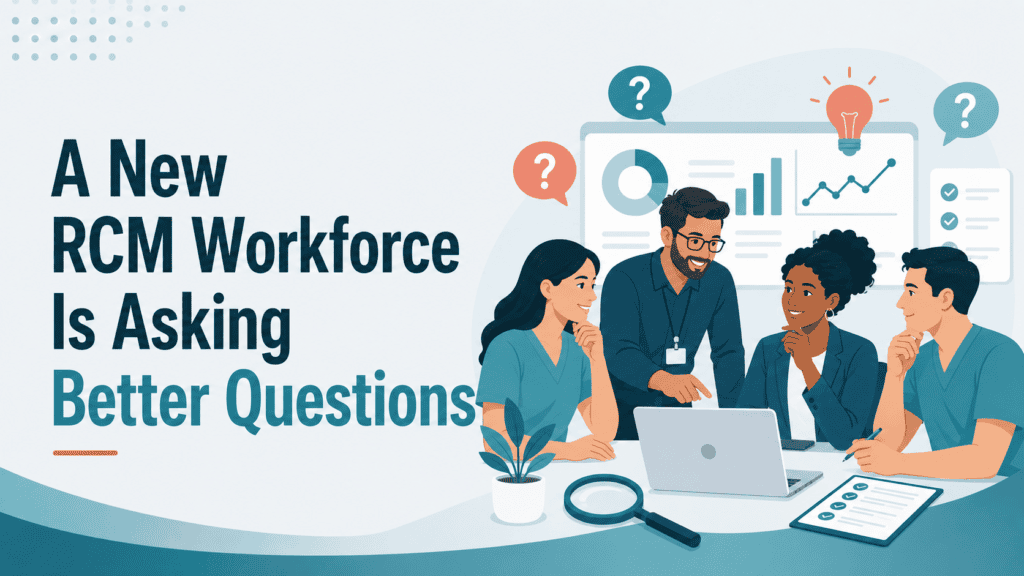
A New Workforce Is Asking Better Questions
The next generation of RCM employees is different. They are more comfortable with technology. They expect better systems. They want to understand the purpose behind their work. They are more willing to challenge processes that feel outdated or inefficient.
That can frustrate leaders who came up through a more traditional production model. But it can also be a major advantage.
Your employees are asking the questions every RCM owner should already be asking.
Why are we still doing this manually?
How does this task affect the provider, the patient, and the payment outcome?
Where is the career path in this role?
Why are we measuring activity when we should be measuring results?
These are not bad questions. They are growth questions.
The problem is that many RCM roles were designed for a different era. Too many people are still trained to keep their heads down, work the queue, hit the number, and move to the next account. That may produce short term output, but it does not build a scalable company.
When employees do not understand the bigger picture, they do not improve the process. They simply survive it.
Automation Changes the Role of the RCM Employee
Automation is already removing some of the most repetitive work in revenue cycle operations. Eligibility checks, claim status follow up, payment posting support, denial routing, and reporting tasks are becoming more automated every year.
That does not mean people become less important.
It means their work becomes more important.
As repetitive work moves to technology, your team needs to become better at handling exceptions, spotting trends, communicating with clients, escalating payer issues, improving workflows, and protecting the patient financial experience.
The best RCM employees of the future will not just process work. They will interpret work.
They will know when a denial pattern signals a documentation issue. They will know when a payer is creating friction across multiple clients. They will know when automation is producing the wrong result. They will know when a patient balance process is technically correct but damaging the provider relationship.
That kind of judgment cannot be built in a culture that treats people like keystroke machines.
Outsourcing Requires Stronger Leadership, Not Less Leadership
Many RCM companies now rely on offshore teams, vendors, contractors, and remote employees. That can create real operational leverage. It can also create fragmentation if leadership is not intentional.
Outsourcing should never mean out of sight, out of mind.
If offshore or vendor teams are doing important work for your clients, they need clear workflows, clear quality expectations, good training, timely feedback, and a real connection to the mission. They need to understand more than the task. They need to understand the consequence of the task.
A dispersed team can still be a connected team, but only if the owner and leadership team build that connection on purpose.
When your stateside team and offshore team feel like two separate companies, you do not have a time zone problem. You have an operating problem.
Owners need to ask hard questions.
Do all teams understand the same standards?
Are offshore teams trained on the why behind the work?
Are vendors included in quality conversations?
Are errors tracked in a way that improves the process, or only in a way that assigns blame?
Are remote employees connected to the client mission, or only to the production queue?
The companies that answer these questions well will create stronger teams and more dependable outcomes.
Healthcare Is Changing Faster Than Many RCM Operations
Patient expectations have changed. Provider expectations have changed. Payer behavior has changed. Technology has changed. Client communication has changed.
But inside many RCM companies, the operating model has not changed enough.
Job descriptions are often outdated. Manual processes remain in place because no one has had time to rebuild them. Career ladders are unclear. Training is too narrow. Productivity is still measured by activity instead of outcomes.
That is a dangerous place for an RCM company owner.
Your best employees have options. If they feel trapped in outdated systems, they will leave. If they do not see a future inside your company, they will look elsewhere. If they are only measured by volume, they will stop thinking strategically.
And when good people leave, the cost is bigger than recruiting.
You lose client knowledge. You lose payer knowledge. You lose process knowledge. You lose momentum.
The Future RCM Team Must Be Built Differently
A modern RCM team has to be tech savvy, mission driven, and human centered.
Tech savvy means your team is trained to use systems, automation, dashboards, and reporting tools with confidence. They should not fear technology. They should understand how to use it to produce better results.
Mission driven means your team understands that revenue cycle work protects the financial health of the provider and the access experience of the patient. Claims, denials, payments, and statements are not just transactions. They are part of the healthcare experience.
Human centered means the team remembers that every balance belongs to a person, every delay affects a practice, and every process either creates trust or damages it.
For RCM owners, this is where the business opportunity lives.
A stronger workforce creates better client outcomes. Better client outcomes create stronger retention. Stronger retention creates more stable revenue. More stable revenue gives you the room to grow with less chaos.
This Is a Leadership Issue
RCM owners cannot lead the next generation of revenue cycle with the old production mindset alone.
The future belongs to leaders who can do five things well.
They must recognize talent, not just tenure.
They must welcome feedback, especially when it exposes an inefficient process.
They must build flexibility without losing accountability.
They must invest in upskilling, not just staffing.
They must choose technology and vendor partners that help their team become more effective, not more fragmented.
The RCM companies that grow in the next decade will not be the ones that simply add more people to broken processes. They will be the ones that redesign the work, develop better leaders, and give their teams the tools and purpose they need to perform at a higher level.
Billing teams do not look like they used to.
That is not a problem.
It is an opportunity.
The RCM owners who understand that first will build stronger companies, keep better people, and deliver better experience for the providers they serve.
Frequently Asked Questions
What is cost per appealed dollar?
Should an RCM company ever write off a valid claim on purpose?
How do you lower your cost per appealed dollar?
About the Author
Thomas Koehl is a 30 year health technology veteran and currently Director of Marketing at Harris CareTracker. Prior leadership roles at QRS Healthcare Solutions focused on supporting revenue cycle management partners. Following Hurricane Katrina, he served as Director of a large New Orleans medical clinic that delivered care to over 32,000 patients. Koehl has testified before the U.S. House Committee on Energy and Commerce as an expert witness on disaster healthcare delivery. He also volunteers as COO of International Medical Alliance, a nonprofit providing free medical care to impoverished communities in developing countries. He writes about the business, strategy, and human side of health technology for the practitioners and leaders living it day to day.
Follow me here for more breakdowns, and follow HARRIS CareTracker for product updates and resources.



One Response
Simply want to say your article is as astounding. The clearness in your post is just great and i can assume you’re an expert on this subject. Well with your permission let me to grab your feed to keep up to date with forthcoming post. Thanks a million and please carry on the rewarding work.