The fastest way to improve clean claim rates may have nothing to do with your claims process. It starts inside the exam room.
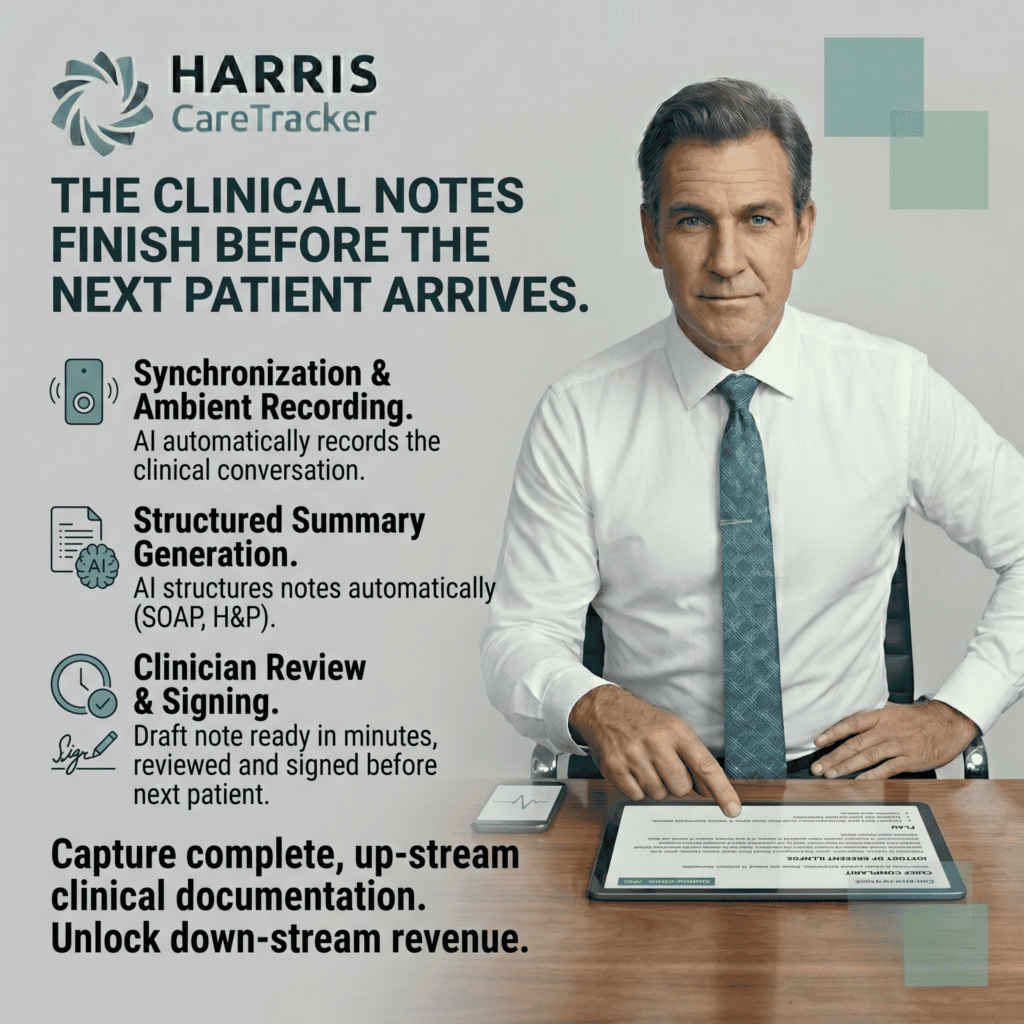
Ambient listening is AI that records the conversation between a provider and a patient during a clinical encounter, then converts that conversation into a structured clinical note automatically. The provider talks to the patient. The AI listens in the background. A draft note appears in minutes. The provider reviews, edits if needed, and signs. Documentation that used to take 15 minutes after a 10-minute visit now finishes before the next patient walks in.
That is what ambient listening is. Everything below explains how it works, why it matters for billing companies and the practices they serve, and what HARRIS CareTracker built with Amplify to solve the documentation problem that has been destroying provider productivity and downstream revenue for years.
As the medical director in a clinic before coming to HARRIS CareTracker, I watched the same pattern. The clinical encounter takes 10 to 15 minutes. The documentation takes twice that. Providers skip lunch to catch up on charts. Evenings disappear into documentation cleanup. Weekends include finishing notes from Thursday. And the downstream billing operation inherits whatever that exhausted provider managed to type into the EHR at 9 PM, which is rarely the quality of documentation that supports accurate coding and clean claim submission.
Ambient AI does not just solve a provider convenience problem. It solves a revenue cycle problem. And that is the angle most people miss.
The Documentation Problem That Creates Revenue Problems
More than half of billing teams spend 51 to 75% of their time on repetitive administrative tasks. A large portion of that time goes toward chasing problems that started with incomplete or inaccurate clinical documentation. Missing diagnoses. Vague chief complaints. Absent review of systems. Plan sections that say “continue current management” without specifying what that means.
Every one of these documentation gaps becomes a coding problem. Every coding problem becomes a claim problem. Every claim problem becomes a denial or an underpayment. And every denial costs $25 to $118 to rework.
The provider is not trying to create problems. They are trying to survive a workload that requires them to see 25 patients and document 25 charts in the same number of hours. Something gives. Usually it is documentation quality. And the billing company absorbs the downstream cost.
This is the root cause that ambient listening addresses. Not by asking the provider to document differently. By eliminating the separation between the encounter and the documentation. When the note writes itself from the conversation that already happened, documentation quality improves because nothing gets lost between the exam room and the EHR.
How Ambient AI Actually Works Step by Step
Ambient listening technology follows a specific workflow that is worth understanding in detail because the mechanics determine the quality of the output.
Step one is encounter synchronization. The patient appointment syncs from the EHR automatically. Encounter details populate including patient name, chief complaint, visit type, and provider assignment. There is no manual setup. The system knows who the patient is and what kind of visit this is before the provider taps record.
Step two is ambient recording. The provider starts the encounter and the AI records the conversation in the background. Speaker identification separates the provider’s voice from the patient’s voice automatically. Medical terminology recognition handles clinical vocabulary, medication names, and specialty jargon. The recording captures everything said during the encounter, including history the patient shares, questions the provider asks, physical exam findings communicated verbally, and the treatment plan discussed.
Step three is AI transcription. After the recording stops, AI processes the audio into a transcript. This is not general purpose speech to text. It is medical grade transcription trained on clinical conversations. It handles anatomy, procedures, medications, and diagnoses with accuracy that consumer transcription tools cannot match.
Step four is clinical summary generation. AI organizes the transcript into structured clinical sections: Chief Complaint, History of Present Illness, Past Medical History, Medications, Family History, Social History, Review of Systems, Psychiatric History, Treatment, and Plan. Each section shows capture status indicating whether content was identified in the conversation. If the patient did not discuss family history, the system marks that section as not captured rather than fabricating content.
Step five is clinician review. The provider reviews the structured summary. They edit any section using a rich text editor. They add physical exam findings that were not spoken aloud during the visit. They insert test results reviewed after the encounter. They correct anything the AI misunderstood.
Step six is note generation. The system generates a draft note in SOAP format for routine encounters or detailed History and Physical format for new patients and complex visits. Generation takes 10 to 20 seconds. The provider reviews, edits, and signs. Digital signature applies with timestamp, clinician identifier, and signature method. The signed note locks and becomes part of the legal medical record.
The full workflow from recording to signed note takes minutes. Not hours. Not the next morning. Minutes.
Why This Matters for Billing Companies
If you run a billing company with 1 to 50 employees, ambient listening technology at your client practices changes the quality of the clinical documentation you receive. And documentation quality is the single largest upstream driver of your clean claim rate, your denial rate, and your net collection rate.
When a provider documents during the conversation rather than hours later from memory, the note captures details that get lost in delayed documentation. The specific medication dose discussed. The exact symptom timeline the patient described. The review of systems responses that support the E/M level billed. The plan details that establish medical necessity for the procedure ordered.
For billing companies managing claim denial management, this matters directly. Missing or vague documentation is the root cause behind coding downgrades, medical necessity denials, and prior authorization failures. When the documentation is complete because it was captured in real time from the actual conversation, the coding is more accurate. When the coding is more accurate, the clean claim rate goes up. When the clean claim rate goes up, days in A/R comes down and your cost to collect drops.
Ambient listening does not replace your coders or your billers. It gives them higher quality raw material to work with. And in revenue cycle management, the quality of the raw material determines the quality of everything downstream.
What HARRIS CareTracker Built with Amplify
Amplify is the HARRIS CareTracker ambient listening AI assistant. It is built for integration with the HARRIS CareTracker EHR and practice management platform. Encounter synchronization, note insertion, and billing workflow integration run through a single connected system.
Here is what differentiates Amplify from standalone ambient tools.
HIPAA compliant ambient documentation with end to end encryption. Audio recordings encrypt during upload. Transcripts and clinical summaries encrypt at rest. Data transmission uses encrypted connections throughout the workflow. This is not a consumer recording tool with a HIPAA disclaimer. Security is built into every step.
Complete audit logging. Every access event, edit, note generation, code review, and signing action logs with user identifier, timestamp, and activity type. Audit trails support compliance reviews, security investigations, and legal requirements. When a signed note becomes part of the legal medical record, the complete chain of custody is documented.
Role based access controls. The provider role can record, review, edit, generate notes, and sign. The staff role can view encounters and read transcripts but cannot record, edit, or sign. The admin role manages users and organization settings. Permissions enforce appropriate access at every level.
Speaker identification and medical terminology recognition. Amplify separates provider speech from patient responses automatically. Medical terminology, medication names, and specialty vocabulary process with clinical grade accuracy. Primary care wellness visits, acute single problem encounters, behavioral health sessions, and follow up visits with straightforward documentation generate complete summaries requiring minimal review.
Offline recording continuity. If connectivity drops during an encounter, recording continues locally on the device. Upload occurs automatically when connectivity returns. Processing begins after upload completes without data loss. The visit does not get disrupted by a network issue.
Patient consent workflows. Recording instructions emphasize obtaining patient consent before starting ambient capture. Patients are informed that recording serves documentation purposes. Opt out requests are respected. Consent is a clinical and legal requirement, and Amplify builds it into the workflow.
The Connection Between Documentation and Revenue That Most People Miss
A provider who documents from memory at 9 PM after a 12 hour day will miss details. Not from negligence. From fatigue. Those missing details cost your billing operation money every single day.
A diagnosis that gets left out of the note cannot be coded. A review of systems that is not documented cannot support the E/M level. A treatment plan that says “discussed options” without specifying which options cannot establish medical necessity. And every one of those gaps creates a denial, a downcode, or an underpayment that your team has to chase.
Ambient listening fixes this at the source. The conversation is the documentation. The details get captured because they were spoken, not remembered. The note is complete because the AI heard everything and organized it into clinical structure.
For billing companies, this is the upstream fix that most downstream denial prevention cannot touch. You can scrub claims, verify eligibility, and run automated edit checks. But if the clinical note does not support the code, nothing downstream saves you. Ambient listening fixes the note. And when the note is right, the revenue cycle works.
Contact your HARRIS CareTracker Customer Success Manager to learn about Amplify.
Follow for more on revenue cycle management, clinical documentation, and building billing operations that capture every dollar of earned revenue.
Frequently Asked Questions
What is ambient listening in healthcare?
How does ambient listening affect billing and revenue cycle management?
Is ambient listening HIPAA compliant?
What types of visits work best with ambient listening technology?
How long does it take to get a finished note from an ambient listening recording?
About the Author
Thomas Koehl is a 30 year health technology veteran and currently Director of Marketing at Harris CareTracker. Prior leadership roles at QRS Healthcare Solutions focused on supporting revenue cycle management partners. Following Hurricane Katrina, he served as Director of a large New Orleans medical clinic that delivered care to over 32,000 patients. Koehl has testified before the U.S. House Committee on Energy and Commerce as an expert witness on disaster healthcare delivery. He also volunteers as COO of International Medical Alliance, a nonprofit providing free medical care to impoverished communities in developing countries. He writes about the business, strategy, and human side of health technology for the practitioners and leaders living it day to day.
Follow me here for more breakdowns, and follow HARRIS CareTracker for product updates and resources.