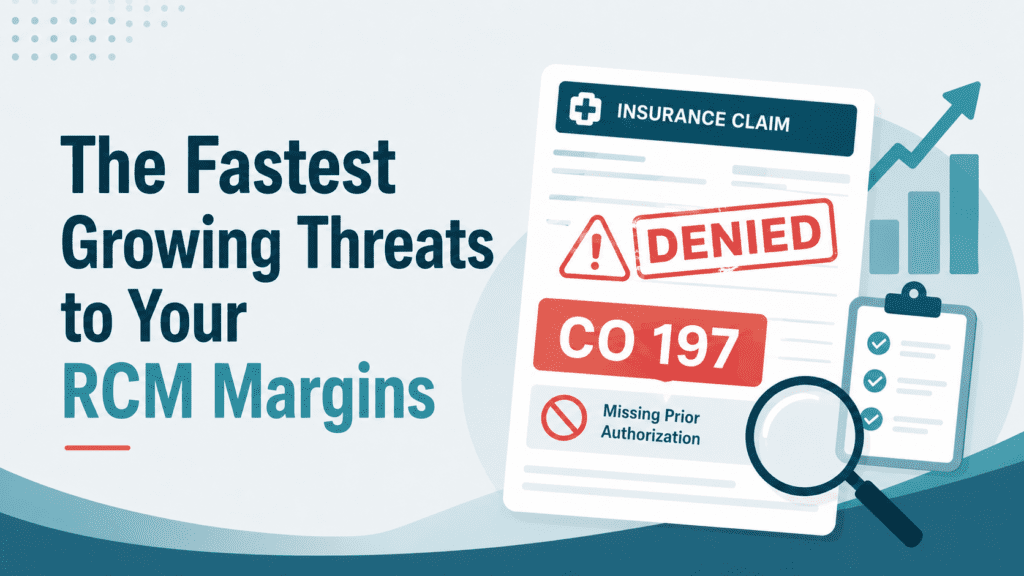
90% of denied claims require manual rework. Physicians spend an average of 16 hours per week on authorization related tasks. And the industry is seeing a 20% annual increase in prior authorization requirements for prescription drugs alone.
RCM companies managing prior authorization through manual workflows surrender 15 to 25% of staff productivity to rework cycles that generate zero incremental revenue. On 2 to 4% industry margins, that overhead isn’t sustainable. It’s terminal.
Why CO 197 Behaves Differently Than Other Denial Categories
Prior authorization failure is rarely one person’s mistake. It’s a symptom of fractured workflow architecture that compounds across every client practice your RCM company serves.
The information pull bottleneck. Clinical staff focus on patient outcomes. Administrative staff focus on insurance requirements. That divide creates constant friction where administrative teams have to hunt down clinical data, progress notes, proof of failed conservative therapies, to satisfy payer criteria. If clinicians fail to use payer mandated phrases, the authorization request gets rejected before the service ever occurs.
The accountability vacuum. Internal delegation of PA tasks is notoriously ambiguous. The ordering physician assumes intake staff confirmed authorization during scheduling. Intake staff assumes billing handles payer communications. Clinical staff assumes the authorization number automatically flows from EHR to claim. When nobody owns the outcome, everybody absorbs the loss.
The technical mismatch trap. Authorization is obtained for the wrong service code, wrong diagnosis, or incorrect place of service. Or the PA exists but expired. Or approved units weren’t tracked. Or the patient’s insurance changes mid episode but nothing in the system forces re verification.
For RCM companies, these failures don’t create isolated claim denials. They create systematic margin erosion across entire client portfolios. Each rework cycle costs $25 to $117 in administrative labor, consuming staff capacity that should be driving revenue instead of chasing it.
Where the Exposure Concentrates
CO 197 risk isn’t distributed evenly. High cost, complex services are prime targets for aggressive utilization management, and these categories dominate specialty practice revenue.
High cost imaging. MRIs, CT scans, PET scans, and nuclear medicine carry charge amounts where a single authorization failure can wipe out the margin on dozens of clean claims.
Outpatient surgeries and procedures. Endoscopy, pain management injections, orthopedic procedures, and cardiac catheterizations require precise CPT alignment between authorization and claim. One code mismatch and the authorization is worthless.
Specialty drugs and infusions. Biologics, chemotherapy, rheumatology, and GI infusions often carry strict step therapy requirements. The authorization exists, but documentation of failed conservative therapies wasn’t captured correctly, and the claim denies anyway.
Same day procedure and Modifier 25 visits. When a problem oriented service is provided the same day as a preventive exam, insurers use automated edits to deny the second service. Missing pre service authorization for the specific procedure code triggers immediate rejection.
DME and rehabilitation. Wheelchairs, orthotics, sleep equipment, and multi visit plans for physical, occupational, or speech therapy require ongoing unit tracking that manual workflows cannot sustain over the life of a treatment plan.
At HARRIS CareTracker, we’ve focused on automated flagging that prevents scheduling finalization until PA status is confirmed. You can’t accidentally schedule a patient for a service that hasn’t been authorized if the system won’t let you move forward without clearing it.
What Systematic Prevention Actually Looks Like
Organizations relying on manual workflows face industry average denial rates of 10% or higher. Organizations on AI optimized platforms achieve denial rates as low as 4%. That 6 point gap, applied across hundreds of thousands of annual claims, is the difference between sustainable margins and a business that slowly bleeds out.
Five stages, each one a potential failure point:
Stage 1:
Requirement Identification. Check health plan policy rules and formularies for specific CPT codes. Rules vary significantly even within a single payer’s portfolio. Asking “does this plan require PA” isn’t specific enough. You need to know whether this specific code, for this specific diagnosis, under this specific plan version, requires authorization.
Stage 2:
Documentation Aggregation. Gather clinical evidence establishing medical necessity before authorization submission. Medical records, peer reviewed research aligned with payer specific medical policy, proof of step therapy completion. If documentation is incomplete at this stage, you’re guaranteeing rework downstream.
Stage 3:
Formal Submission. Attest to accuracy and track the unique payer assigned request number. Ordering provider attestation is critical. Payers reject requests lacking licensed provider signature, creating delays that push services past authorization windows.
Stage 4:
Status Monitoring. Use EDI 277 transactions for proactive automated follow up. This eliminates the dead air that contributes to the 16 hour weekly administrative burden physicians report. Manual status checking doesn’t scale across multiple client practices. It barely scales across one.
Stage 5:
Pre Service Resolution. Address redirections to lower cost sites or administrative denials for missing data before the patient arrives. Catching problems at this stage keeps the claim from ever entering the denial rework cycle.
HARRIS CareTracker enforces checkpoints at each stage through integrated claims management capabilities. RCM companies on the platform have seen significant reductions in CO 197 denials and meaningful cost avoidance, typically within the first six months.
Structuring Appeals So They Actually Recover Revenue
Even solid prevention architecture will face unavoidable denials. Whether you recover that revenue or abandon it comes down to one thing: is your appeals workflow systematic, or is your team reacting to each denial individually?
Triage first. Determine if the denial is soft (missing data, wrong CPT code) or hard (service never covered, filing window missed). Check if an authorization number exists but was simply omitted from the claim. If so, resubmit as a corrected claim without filing a formal appeal. This is faster and cheaper than the appeals process.
Pursue retroactive authorization. Many payers allow retro authorization for medical emergencies, administrative errors, or extenuating circumstances if you can prove the service could not be delayed. Most RCM companies never pursue this because their workflow doesn’t surface the opportunity. The option exists. Nobody uses it.
Tier the appeal by complexity:
Level 1 internal appeal addresses administrative errors or minor documentation gaps. Ask the payer to re review with newly attached documentation.
Level 2 peer to peer review is highly effective for clinical and medical necessity denials. This lets the treating physician bypass automated AI denial systems and explain clinical nuances directly to the payer’s medical director. For complex cases, peer to peer changes outcomes more than any documentation package.
Level 3 external review through an Independent Review Organization evaluates permanent hard denials for high value services. The IRO decision is legally binding. If the reviewer finds the treatment medically necessary, the insurer must cover the service.
Regulatory timelines that protect revenue: Urgent care appeals require a decision within 72 hours. Pre service claims require decision within 30 days. Post service claims within 60 days. External review requests must be filed within 4 months of the final internal denial.
HARRIS CareTracker’s AI enabled denial analytics identify appeal opportunities by analyzing historical outcomes across payers, denial categories, and clinical contexts. The platform helps surface winnable appeals faster and with stronger supporting data.
Accountability Has to Be Assigned, Not Assumed
Denials stem from role confusion between rendering and ordering providers. For RCM companies managing multiple client practices, this confusion multiplies across every account.
One rule matters more than any framework: each task must have exactly one accountable person. Multiple owners create diffusion of responsibility where deadlines get missed and revenue disappears. When you look at authorization breakdowns, almost every one traces back to a moment where two people each assumed the other was handling it.
Practical accountability assignments that work:
Checking payer rules: administrative staff owns execution, billing manager owns accountability, ordering provider stays informed. Signing medical necessity attestations: administrative staff prepares the documentation, ordering provider owns clinical validity. Monitoring authorization status: RCM specialist owns execution, billing manager owns accountability, rendering provider stays informed. Filing internal appeals: billing specialist owns execution, billing manager owns accountability, ordering provider gets consulted for clinical input.
RCM companies that formalize these assignments across client portfolios see measurable reductions in authorization related denials and meaningful improvement in staff productivity by eliminating the redundant inquiry cycles that waste everyone’s time.
Where This Leaves RCM Company Owners
Prior authorization complexity is accelerating. Payer AI sophistication now exceeds most manual RCM workflows. Step therapy requirements multiply. Documentation standards tighten. And the 20% annual increase in PA requirements shows no sign of slowing.
RCM companies managing authorization through fragmented technology, inconsistent accountability, and reactive appeals workflows face margin erosion they cannot pass through to clients already squeezed by healthcare economics. The 90% manual rework rate isn’t just inefficiency. For companies operating on thin margins, it’s a problem that gets worse with every new payer requirement added to the pile.
CO 197 isn’t an administrative annoyance you can staff your way through. It’s an infrastructure problem. RCM companies that build authorization prevention into their platform, assign clear accountability, and run systematic appeals will hold their margins. Managing this manually, across fragmented systems, with ambiguous ownership? That’s a margin erosion path that only moves in one direction.
About the Author
Thomas Koehl is a 30 year health technology veteran and currently Director of Marketing at Harris CareTracker. Prior leadership roles at QRS Healthcare Solutions focused on supporting revenue cycle management partners. Following Hurricane Katrina, he served as Director of a large New Orleans medical clinic that delivered care to over 32,000 patients. Koehl has testified before the U.S. House Committee on Energy and Commerce as an expert witness on disaster healthcare delivery. He also volunteers as COO of International Medical Alliance, a nonprofit providing free medical care to impoverished communities in developing countries. He writes about the business, strategy, and human side of health technology for the practitioners and leaders living it day to day.
Follow me here for more breakdowns, and follow HARRIS CareTracker for product updates and resources.