Telehealth billing in 2026 runs on two separate coding tracks. Medicare requires standard E/M codes (99202 through 99215) with specific place of service and modifier combinations. The AMA released a new 98000 through 98015 code series for audio video and audio only visits. Medicare rejects 16 of those 17 new codes and pays only one, CPT 98016. Commercial payers vary on whether they accept the 98000 series at all. If your billing team is applying one set of telehealth rules across all payers, you are generating preventable denials on every claim that hits the wrong track.
That is the operational reality for billing companies in 2026. The pandemic era flexibility is gone. Congress extended most Medicare telehealth flexibilities through December 31, 2027, but CMS tightened how codes, place of service designations, and modifiers must be applied. The margin for error collapsed. And for billing companies running 1 to 50 employees across multiple client practices, the compliance burden just multiplied.
Working with clients are the lock downs, I can tell you that a lor of practices and billing companies struggled with Telehealth billing, Not because the rules are impossible. Because the rules are different depending on the payer, and most billing workflows are not built to handle that variation at scale.
The Dual Track System Your Team Needs to Understand
Medicare and commercial payers do not agree on telehealth coding. Your billing team must treat them as two separate billing systems operating under different rules.
For Medicare fee for service, you bill standard office E/M codes 99202 through 99215. You do not use the AMA 98000 series. You identify the visit as telehealth through the place of service code, either POS 10 (patient at home) or POS 02 (telehealth location). You append modifier 93 for audio only visits. Medicare does not require modifier 95 because CMS identifies telehealth through the POS code alone.
There is one exception. CPT 98016 is the single code from the new AMA series that Medicare reimburses. It replaced the old HCPCS code G2012 for brief virtual check ins and pays approximately $16.50. Every other code in the 98000 through 98015 series triggers an automatic denial under RARC N776 if billed to Medicare. That is not a soft edit. That is an automatic rejection.
For commercial and Medicaid payers, the rules vary by plan. A portion adopted the 98000 series. Others did not. Certain plans require modifier 95 for video visits. Others require modifier 93 for audio only. Others require both. Your team must verify each payer’s telehealth billing policy individually rather than applying a universal rule. There is no universal rule.
For FQHCs and RHCs billing as distant sites, the code is G2025 at a flat rate of $97.53. Modifier FQ is required, plus modifier 93 if the visit is audio only.
This payer by payer variation is where most billing companies create denials. A coder who correctly bills a telehealth E/M visit to Medicare using POS 10 and modifier 93 will generate a denial if they apply the same approach to a commercial payer that requires modifier 95 and does not recognize POS 10. The claim is coded correctly for one payer and incorrectly for another. Same visit. Same provider. Different denial.
The POS 10 Mandate and the POS 02 Denial Trap
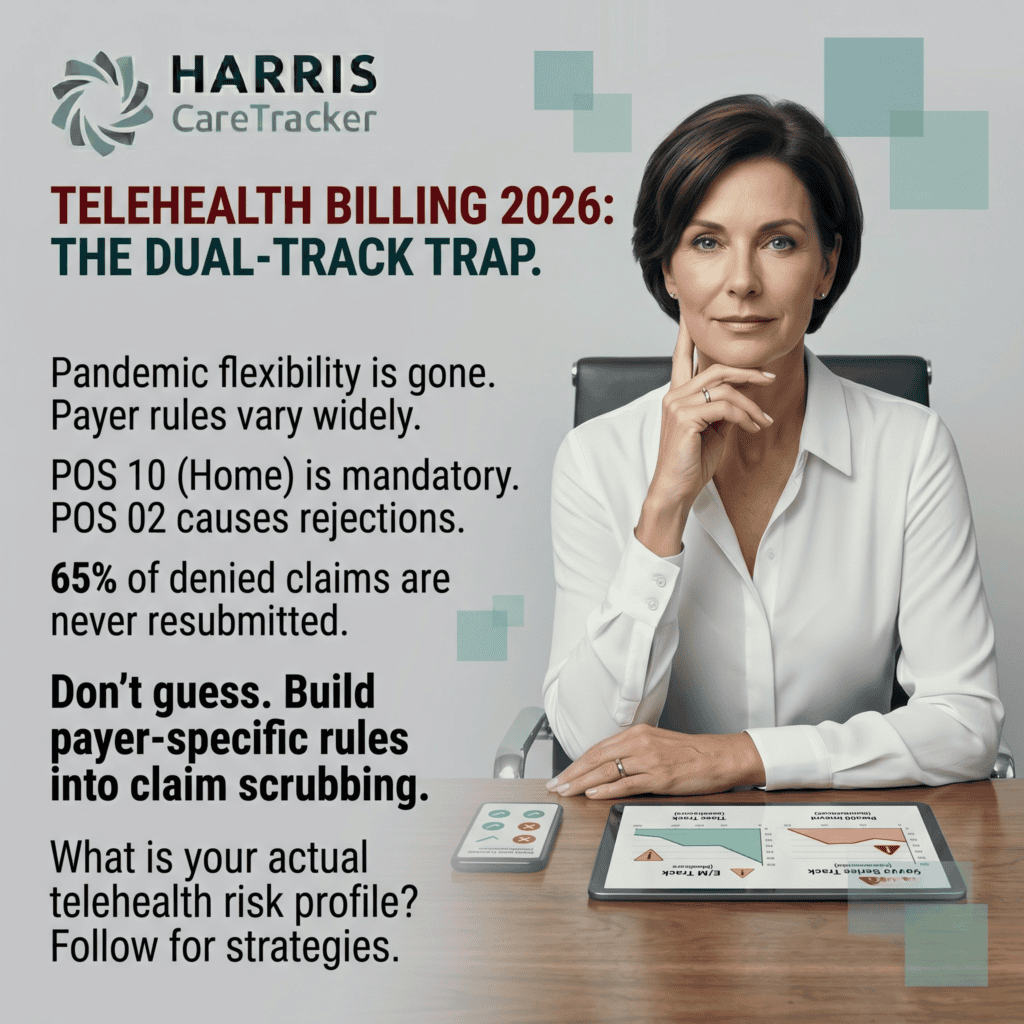
As of March 2026, POS 10 (patient at home) is mandatory for most telehealth claims where the patient is not at a healthcare location. POS 02, which was the default telehealth designation for years, now triggers automatic denials from most payers.
This is a change that should take five minutes to implement and zero dollars to fix. Update the default POS code in your billing system from 02 to 10 for telehealth encounters. But across the billing companies I work with at HARRIS CareTracker, this single coding change was missed by a surprising number of operations, and the denials accumulated for weeks before anyone traced them to the POS code.
The financial impact of correct POS coding goes beyond compliance. For most E/M services delivered via telehealth, Medicare pays the office based rate regardless of POS. The office based rate is higher than the hospital based rate in most cases. Getting the POS right is not just about avoiding denials. It directly affects your reimbursement amount.
Modifier Rules That Trip Up Billing Teams
Three modifiers govern telehealth billing in 2026, and the rules for when to use each one are not consistent across payers.
Modifier 95 signals a synchronous audio video telehealth visit. Commercial payers and Medicare Advantage plans require it on standard E/M codes. Medicare fee for service does not require it because CMS identifies telehealth through POS codes. Multiple billing guides recommend appending modifier 95 on all telehealth claims regardless of payer to avoid confusion, unless a payer explicitly excludes it.
Modifier 93 signals an audio only visit billed under standard E/M codes. Both Medicare and most commercial payers require it when the visit is conducted by phone without video.
Modifier FQ is a newer requirement that certain payers now require specifically for audio only services, separate from modifier 93. This distinction catches billing teams off guard because FQ was previously associated only with FQHC and RHC distant site claims. Its use is expanding, and your team needs to verify payer specific requirements.
The most common modifier errors flagged in 2026 billing audits are missing modifier 95 or 93 altogether, billing audio only services without documented patient eligibility for audio only, using POS 02 when POS 10 is required, and billing non covered codes as telehealth.
Behavioral Health: The Most Covered and Most Misapplied Category
Mental health is the most robustly covered telehealth category. Standard psychotherapy codes 90832, 90834, 90837, 90791, and 90792 are all fully covered via telehealth under Medicare.
But Medicare imposes a requirement that billing teams frequently misapply: patients must complete an in person visit with the provider, or another provider in the same practice group, within 6 to 12 months before receiving telehealth mental health services. If that in person visit did not happen, the telehealth claim is not covered. This rule is scheduled to return fully in 2028 after current flexibilities expire, and billing companies serving behavioral health practices need to track in person visit compliance for every patient receiving telehealth mental health services.
Audio only coverage for non behavioral services is limited under Medicare. Do not assume that audio only flexibility in behavioral health extends to other specialties. It does not.
RPM and CCM Are Not Telehealth. Stop Billing Them That Way.
A frequent billing error is treating Remote Patient Monitoring codes (99453, 99454, 99457, 99458) and Chronic Care Management codes (99490, 99491, 99487, 99489) as telehealth services. They are not telehealth. They bill under separate non face to face care management rules. They should never receive telehealth POS codes or modifiers.
CMS tightened documentation requirements around RPM device supply and treatment management rules in 2026. Auditors are targeting these codes more closely. Billing companies that append telehealth POS or modifiers to RPM and CCM claims are creating audit exposure for their clients alongside the immediate denial.
At HARRIS CareTracker, our platform supports both telehealth billing and RPM/CCM billing through separate, properly configured workflows. The system does not allow telehealth POS codes or modifiers on care management claims. That distinction is built into the workflow, not left to the coder to remember.
What Your Billing Company Needs to Do This Week
Audit your POS defaults. If any telehealth encounter template in your system still defaults to POS 02, change it to POS 10 today. This is the single fastest denial reduction fix in telehealth billing right now.
Build payer specific telehealth rules into your claim scrubbing. Medicare, commercial, and Medicaid payers all require different code, POS, and modifier combinations. Your automated claim scrubbing rules need to apply the correct combination based on the payer on the claim, not a universal telehealth rule. At HARRIS CareTracker, payer specific scrubbing rules catch these mismatches before claim submission.
Verify your 98000 series billing policy by payer. If your team is billing any code from 98000 through 98015 to Medicare, those claims are being denied under RARC N776. The only Medicare payable code in this series is 98016 for virtual check ins.
Track in person visit compliance for behavioral health telehealth patients. Every patient receiving telehealth mental health services under Medicare must carry a documented in person visit within the required window. If your billing system does not track this, you are submitting claims that will be denied or recouped.
Separate your RPM and CCM workflows from your telehealth workflows. These are different billing categories with different rules. Mixing them creates denials and audit exposure.
The 3.85% increase in overall physician reimbursement rates for 2026, combining a 2.50% statutory increase with budget neutrality adjustments, is a modest tailwind for telehealth heavy practices. But that tailwind only materializes if the claims are coded correctly. Every telehealth billing error erases the reimbursement gain on top of it.
What percentage of your telehealth claims are still going out with POS 02?
Follow for more on revenue cycle management, claim denial management, and building billing operations that keep pace with payer rules.
Frequently Asked Questions
Why does Medicare reject the AMA 98000 through 98015 telehealth code series?
What is the difference between POS 02 and POS 10 for telehealth billing?
When is modifier 95 required versus modifier 93 for telehealth claims?
Are RPM and CCM codes considered telehealth services?
What is the in person visit requirement for telehealth mental health services under Medicare?
About the Author
Thomas Koehl is a 30 year health technology veteran and currently Director of Marketing at Harris CareTracker. Prior leadership roles at QRS Healthcare Solutions focused on supporting revenue cycle management partners. Following Hurricane Katrina, he served as Director of a large New Orleans medical clinic that delivered care to over 32,000 patients. Koehl has testified before the U.S. House Committee on Energy and Commerce as an expert witness on disaster healthcare delivery. He also volunteers as COO of International Medical Alliance, a nonprofit providing free medical care to impoverished communities in developing countries. He writes about the business, strategy, and human side of health technology for the practitioners and leaders living it day to day.
Follow me here for more breakdowns, and follow HARRIS CareTracker for product updates and resources.