THE DOCUMENTATION TRAP
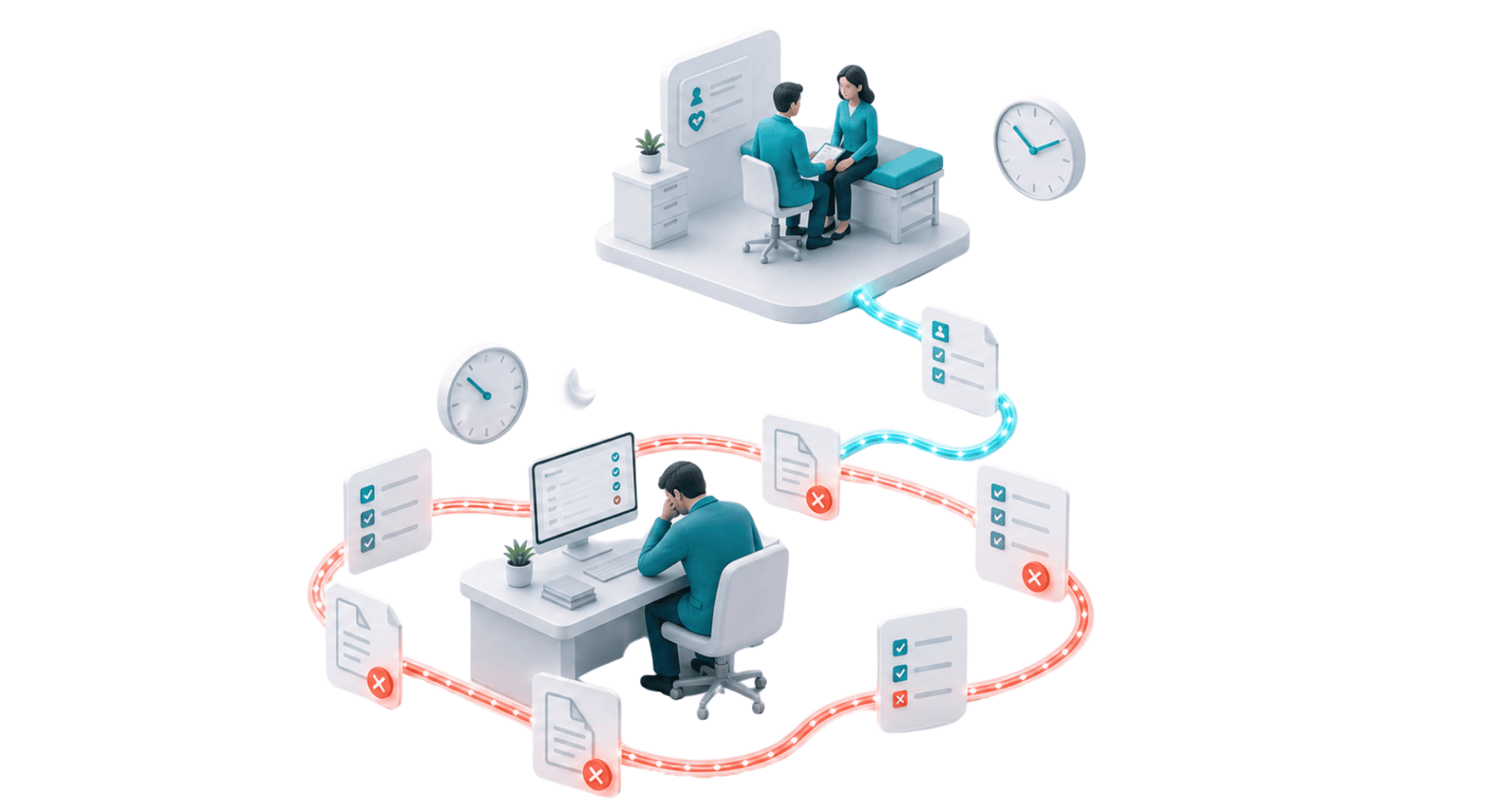
The visit ended at 2:15. The work ends at 10.
Somewhere along the way, finishing the chart became something clinicians do on their own time. Nobody agreed to that. It just accumulated, one workflow at a time, until it looked normal. This page is about how that happened, what it costs, and why the fixes everyone has tried keep failing.
Why Choose Us?

No EHR Switch Required

No long-term Contract

No Mystery Fees
What Actually Removes
The figures below come from peer-reviewed studies of physician time and physician burnout. None of them come from a software vendor.
01. It removes your attention
Clinicians in ambulatory practice spend 49.2 percent of the office day on the EHR and desk work, compared with 27 percent in direct face time with patients: nearly two hours of screen and paperwork for every hour spent with a patient.
Inside the exam room itself, with the patient sitting right there, 37 percent of the time goes to EHR and desk work.
The split has a cost to the clinician, not just to the visit. A systematic review of 53 studies found that clinicians were often unsuccessful at concentrating on complex computer interactions while attending to the patient; EHR use was associated with increased gaze shifts and interruptions in speech.
— Alkureishi et al., Journal of General Internal Medicine, 2016
Source detail: Sinsky et al. was a time-and-motion study of 57 physicians across four specialties and 430 observed hours.
02. It removes your evenings
Family medicine clinicians spend 5.9 hours of an 11.4-hour workday in the EHR. Of that, 1.4 hours falls outside clinic hours. Clerical work accounts for 44 percent of EHR time, with documentation alone consuming 86 minutes a day.
— Arndt et al., Annals of Family Medicine, 2017 — “Tethered to the EHR”
An hour and a half. Every day. After the day was already over.
That number has a nickname, which tells you how normal it became: pajama time.
03. Eventually it removes the clinician from the practice
In a national study of 6,560 physicians, use of computerized physician order entry was associated with 29 percent higher odds of burnout (OR 1.29, 95% CI 1.12–1.48). Satisfaction with electronic practice tools was low: among physicians using EHRs, 36 percent reported being satisfied or very satisfied.
Editorial accuracy note: The paper reports 54.4 percent overall burnout in its sample, rather than 55.3 percent. It also finds that CPOE—not EHR use alone—remained associated with burnout in the adjusted analysis.
AMPLIFY is HARRIS CareTracker’s Ambient Listening Product.
AMPLIFY listens to the visit and generates a structured note for you to review, edit, and sign.
AMPLIFY drafts the encounter note. You sign. That line never moves.
Here is the real problem
Documentation is not going away, and it should not. The record matters. What has changed is that the record no longer has to be built by hand.
If you’re reading this and you still have encounter notes open, you already know which part of your day this would give back.
FAQs
What are the real benefits of outsourcing medical billing?
What does outsourced billing cost?
Will I lose control of my revenue cycle?
Do I have to change my EHR?
How are billing partners vetted?
How long does the transition take?
What happens to my open AR?
Can I switch back to internal billing later?
How do I know my billing partner is performing?
What Our Customers Say About Us
We chose HARRIS CareTracker for our office because of its cost-effectiveness and since changing to them, we have seen a significant increase in our monthly savings. The standout feature has been the excellent customer support and training!

Tara Warnock
Billing Specialist | Naples Vascular Specialists
It’s really easy to use HARRIS CareTracker Practice Management. Very easy to learn.

Lauren O'Brien
Billing Manager | New England OB/GYN
We have used HARRIS CareTracker in our practice for 5 years, and it has been a wonderful experience. The trainers and on-going support teams are knowledgeable, accessible, and quick to respond to queries. They provided easy-to-follow step-by-step guidance for using the software. They never failed me. I highly recommend CareTracker for practices of any size.
Linda S. Erickson
Billing Specialist | John A. Nassar, MD
Get Started Today
Connect With Us
We are here for anything you need, just drop a line and we’ll get back to you.