Chronic Care Management and Recurring Revenue Programs
Chronic care management, remote patient monitoring, and advanced primary care management turn time your practice already spends into billable revenue.
Why Choose Us?

No Hidden Fees

No Surprise Pricing

Real Support from People Who Know Medical Billing
Chronic Care Management: Turn Unbilled Patient Care Into Recurring Revenue
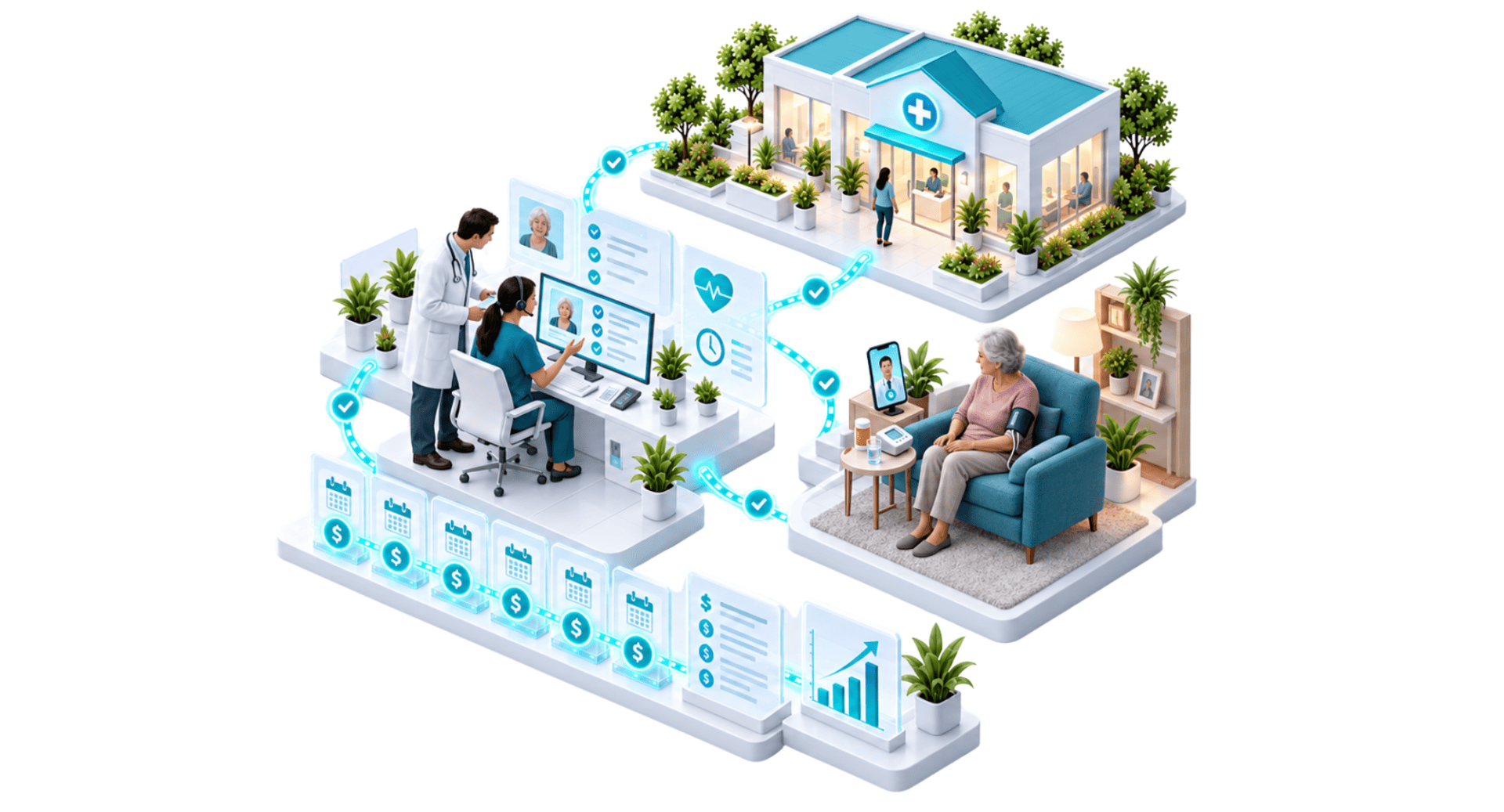
Most of what an independent practice does for a patient between visits, a phone call checking on a medication change, a care plan review, a message answered outside the exam room, has historically gone unbilled. Chronic care management, remote patient monitoring, and advanced primary care management are Medicare programs built specifically to let a practice bill for this time, and together they stand as one of the more direct ways an independent practice adds recurring revenue outside episodic fee for service visits.
CMS‘s own evaluation of the chronic care management program found uptake was higher in small and independent practices than in larger organizations during the program’s first two years, with primary care physicians accounting for 68 percent of claims and 42 percent of billing providers being solo practitioners (Source: Mathematica evaluation for CMS). This guide covers what each program requires, what commonly gets in the way of running one well, and how a connected platform makes the difference between a program paying for itself and one falling short.
What Chronic Care Management Requires
CCM covers a patient with two or more chronic conditions expected to last twelve months or longer, or until death, placing the patient at significant risk of decline. CMS’s billing codes cover the range of a practice’s involvement: 99490 for the first 20 minutes of clinical staff time in a month, 99439 for each additional 20 minutes, 99491 for time personally performed by the physician, and 99487 and 99489 for complex CCM requiring 60 minutes or more with substantial care plan revision (Source: CMS Medicare Learning Network).
Documentation has to include a patient centered electronic care plan and a signed record of consent, since CMS requires the patient understand the program’s availability, any cost sharing, the rule limiting billing to one practitioner per month, and their right to stop the program at any time. An initiating visit is required before CCM begins for a new patient or one the practice has not treated recently.
What Remote Patient Monitoring and Advanced Primary Care Management Add
Remote patient monitoring covers a patient with a chronic or acute condition using an internet connected device digitally uploading data on at least two days within a 30 day period, with billing covering three distinct components CMS requires all be delivered, patient education and device setup, the device itself, and ongoing treatment management using the data. CMS flags education or setup billed but never delivered as a known compliance risk, a reminder RPM billing has to reflect real work, not only device distribution.
Advanced primary care management is a newer, flat monthly payment structure rather than a time based one, with tiers based on the number of chronic conditions a patient has and whether the patient is a qualified Medicare beneficiary. Exact current year payment amounts vary by locality under the Medicare physician fee schedule’s geographic adjustment, so a practice should confirm current rates against CMS’s own fee schedule lookup tool for its specific location rather than relying on a single national figure.
Two More Programs Worth Knowing

Principal Care Management
Principal care management covers a single chronic condition expected to last three months or more, placing the patient at significant risk, rather than the two or more conditions CCM requires. CMS bills PCM under CPT codes 99424 through 99427, covering physician or clinical staff time in monthly increments, and a practice managing a patient through one dominant condition, uncontrolled diabetes or heart failure, for example, uses PCM where CCM’s two condition requirement would not otherwise apply.

Remote Therapeutic Monitoring
Remote therapeutic monitoring is a distinct program from remote patient monitoring, covering musculoskeletal and respiratory therapy adherence and response data rather than physiologic data like blood pressure or glucose. CMS bills RTM under CPT codes 98980 and 98981, and the distinction matters for billing accuracy: a practice tracking physical therapy adherence or respiratory treatment response documents and bills under RTM codes, not the RPM codes covering physiologic monitoring.
What Commonly Gets in the Way
CMS’s own evaluation of the CCM program documented the operational friction practices ran into early on: the time and activity documentation itself was reported as burdensome, numerous electronic health records lacked native tracking for CCM time, and certain physicians were hesitant to raise the required cost sharing conversation with lower income patients out of concern it would strain the relationship. Staffing was also a friction point, since supporting a dedicated care coordination role from CCM revenue alone was harder at low enrollment volumes.
None of this means the programs do not pay off, CMS’s own evaluation found the programs concentrated in small and independent practices specifically, but it does mean the platform running the program matters. A system unable to track qualifying time automatically turns a revenue program into a second documentation burden layered on top of the first one.
Running These Programs on One Platform
HARRIS CareTracker includes built in chronic care management support, so a practice tracks and bills qualifying chronic care time inside the same record it already documents in, rather than running a separate tracking tool alongside the certified EHR. The same connected platform running eligibility, scheduling, and claims for standard visits carries the recurring monthly billing these programs depend on, so a practice does not need to reconcile a second system to run CCM, RPM, or APCM alongside its regular fee for service work.
For a practice weighing whether to add one of these programs, the platform question comes first. A system already tracking time, consent, and care plan documentation inside the patient’s normal chart removes the single biggest operational barrier CMS identified in its own evaluation, the documentation burden making early adopters hesitant to scale the program past a handful of patients.
A Recurring Revenue Program Checklist
Work through these before adding chronic care management, remote monitoring, or advanced primary care management.
- Confirm each candidate patient has two or more qualifying chronic conditions for CCM eligibility
- Document consent covering program availability, cost sharing, and the patient’s right to stop at any time
- Complete the required initiating visit before CCM begins for a new or long absent patient
- For RPM, confirm the device meets the two day of thirty day transmission requirement and all three billing components are delivered as required, not billed on paper alone
- Check current year, locality specific payment rates against the CMS fee schedule lookup tool rather than a single national figure
- Confirm your platform tracks qualifying time and consent inside the same record as the rest of the chart
- Plan staffing so a care coordination role is not asked to support itself from low enrollment volume alone
- Track program revenue and enrollment monthly to see whether it is scaling or stuck at a handful of patients
Go Deeper on Revenue Diversification
Related guides on revenue cycle work and the independence decision behind adding recurring revenue.
Recurring Revenue Built Into the Chart You Already Run
HARRIS CareTracker includes built in chronic care management support, so a practice documents and bills qualifying chronic care time inside the same record it already runs, rather than adopting a separate tracking tool. Consent, care plan documentation, and qualifying time all sit in the certified EHR alongside the rest of the patient’s chart, the operational fix for the documentation burden CMS’s own evaluation identified as the biggest barrier to running these programs at scale.
It is part of HARRIS Healthcare, owned by Constellation Software, with full HIPAA compliance. For a practice adding chronic care management, remote patient monitoring, or advanced primary care management, a platform already tracking the required documentation is the difference between a program growing past a handful of patients and one stalling under its own paperwork.
Who this guide is for. This guide is for an independent primary care owner or administrator considering chronic care management, remote patient monitoring, or advanced primary care management as a new recurring revenue source.
See Recurring Revenue Built into your Existing Chart
Book a walkthrough of HARRIS CareTracker and see how chronic care management tracking and billing run inside the same record as the rest of your practice.
FAQs
What conditions qualify a patient for chronic care management?
What are the main CCM billing codes?
Does a patient need to consent to chronic care management?
What does remote patient monitoring require?
What is advanced primary care management?
Why do practices struggle to scale these programs?
Are these programs mainly used by large health systems?
How does HARRIS CareTracker support chronic care management?
What is principal care management and how is it different from CCM?
What is remote therapeutic monitoring and how does it differ from remote patient monitoring?
Is it possible to bill CCM and PCM for the same patient in the same month?
Which recurring revenue program fits a patient with one dominant condition?
What Our Customers Say About Us
We chose HARRIS CareTracker for our office because of its cost-effectiveness and since changing to them, we have seen a significant increase in our monthly savings. The standout feature has been the excellent customer support and training!

Tara Warnock
Billing Specialist | Naples Vascular Specialists
It’s really easy to use HARRIS CareTracker Practice Management. Very easy to learn.

Lauren O'Brien
Billing Manager | New England OB/GYN
We have used HARRIS CareTracker in our practice for 5 years, and it has been a wonderful experience. The trainers and on-going support teams are knowledgeable, accessible, and quick to respond to queries. They provided easy-to-follow step-by-step guidance for using the software. They never failed me. I highly recommend CareTracker for practices of any size.
Linda S. Erickson
Billing Specialist | John A. Nassar, MD
Get Started Today
Connect With Us
We are here for anything you need, just drop a line and we’ll get back to you.